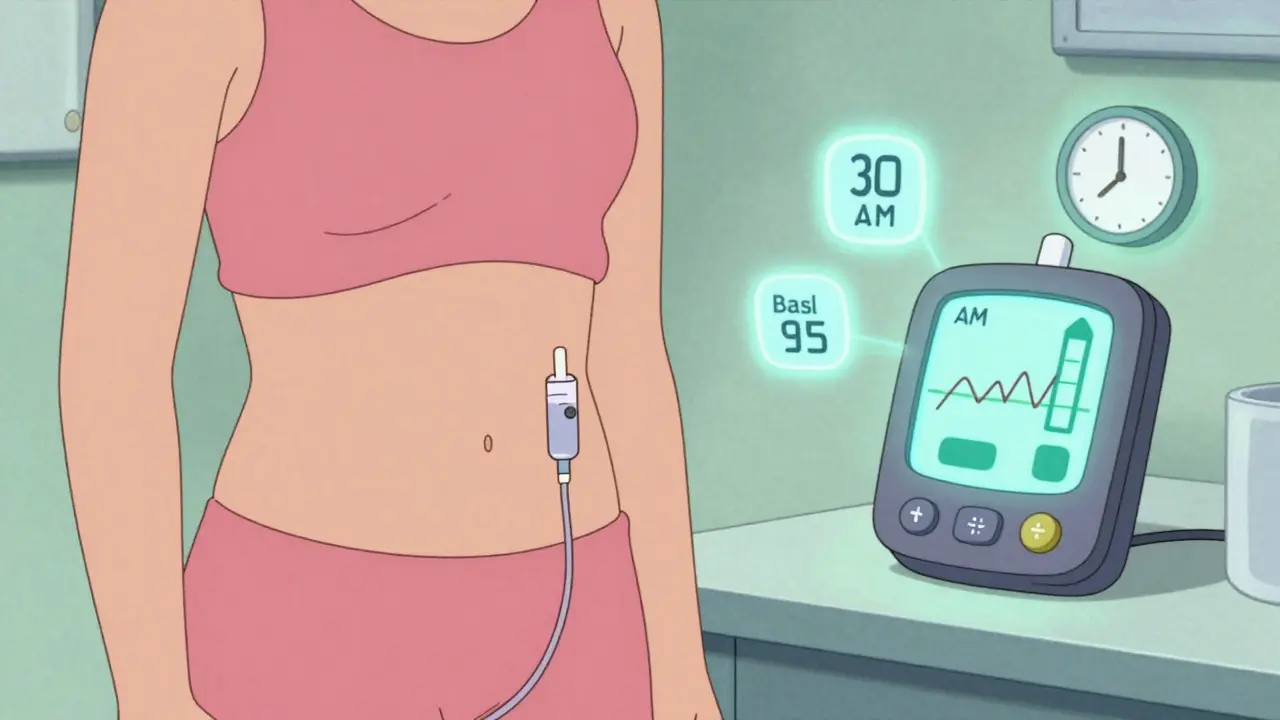
Using an insulin pump isn't just about replacing injections. It’s about learning a new rhythm with your body-one that demands attention, precision, and constant awareness. If you’re considering or already using continuous subcutaneous insulin infusion (CSII), you need to understand how the settings work and what can go wrong if they’re off. This isn’t theory. It’s daily life. One wrong number, one missed alarm, one disconnected tube-and things can turn dangerous fast.
How CSII Works: More Than Just a Pump
CSII delivers insulin through a small, wearable device that connects to your body via a thin plastic tube (infusion set). Unlike multiple daily injections, this system gives you two types of insulin delivery: a steady background dose called the basal rate, and on-demand doses called boluses for meals or high blood sugar. The pump uses only rapid-acting insulin-like Humalog or Novolog-because it’s designed to act fast and clear quickly. You won’t need long-acting insulin anymore. The pump replaces it entirely.
Modern pumps don’t just drip insulin. They adjust. Some, like the Medtronic MiniMed 670G or Tandem Mobi, can sense your glucose levels through a connected continuous glucose monitor (CGM) and automatically slow or stop insulin delivery if your blood sugar starts dropping. But even these advanced systems still require you to tell them when you’re eating. There’s no fully automatic solution yet. You’re still the brain behind the machine.
Setting the Basal Rate: The Foundation of Control
Your basal rate is the silent engine of your pump. It’s the insulin you get 24/7 to keep your blood sugar stable between meals and while sleeping. Most people need different basal rates at different times. For example, you might need more insulin in the early morning (dawn phenomenon) and less during the night. A typical starting point is 40-50% of your total daily insulin divided across 24 hours, but that’s just a guess. The real number comes from testing.
To find your true basal rate, you need a 24-hour fasting test. No food. No boluses. No exercise. Just check your blood sugar every hour. If it rises more than 1 mmol/L (18 mg/dL) over the period, your basal is too low. If it drops, it’s too high. Do this over several days. Most users get it right after 3-4 tests. Dr. John Walsh, author of Pumping Insulin, says improper basal testing is the number one reason pumps fail. Don’t skip this. Your body’s insulin needs change with seasons, stress, illness, and hormones. Re-test every few months.
Carb Ratios and Correction Factors: The Two Key Numbers
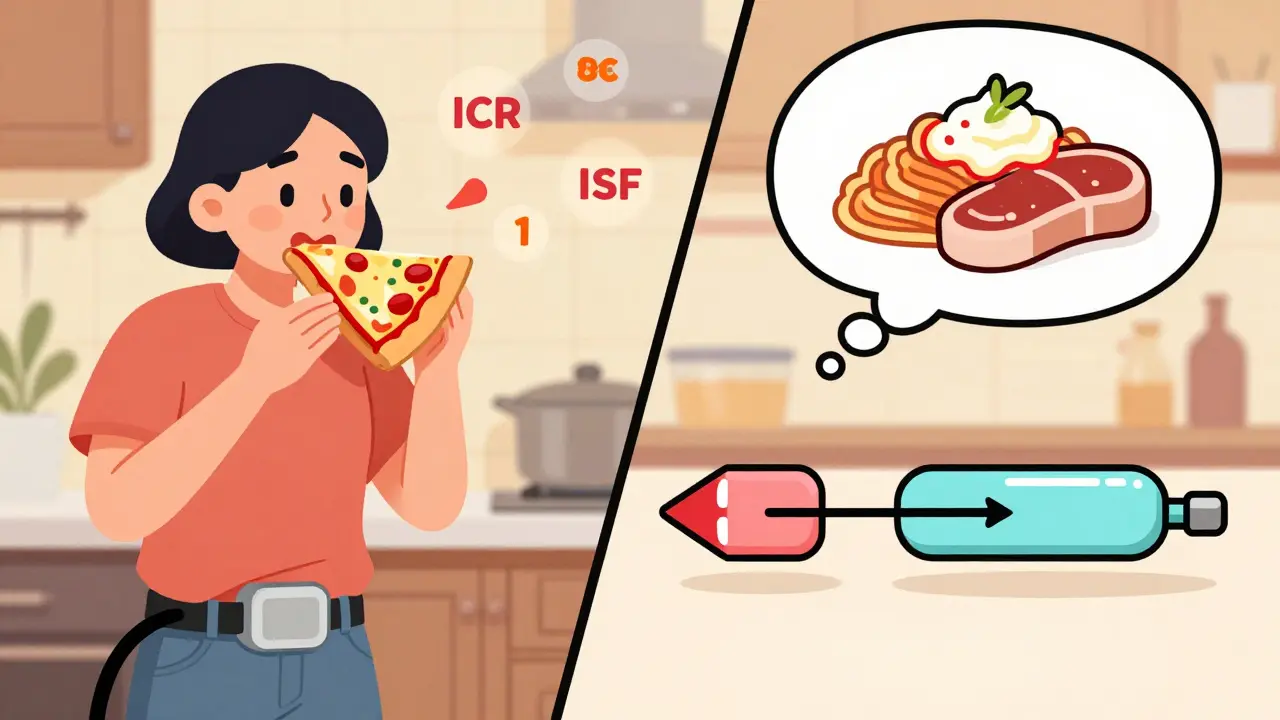
When you eat, the pump needs to know how much insulin to give. That’s where the insulin-to-carbohydrate ratio (ICR) comes in. If your ICR is 1:10, that means 1 unit of insulin covers 10 grams of carbs. For most adults, this starts around 1:8 to 1:15, but it varies wildly. A 120-pound teenager might need 1:6, while a 90kg adult with insulin resistance might need 1:20.
Then there’s the insulin sensitivity factor (ISF)-how much one unit of insulin lowers your blood sugar. If your ISF is 1:3, one unit drops your glucose by 3 mmol/L (54 mg/dL). This helps you correct highs. Most people start with 1:4 or 1:5, but again, test it. To check your ISF, pick a time when your blood sugar is high (say, 12 mmol/L) and give one unit of insulin. Don’t eat. Wait 3 hours. See how much it dropped. Repeat. This isn’t guesswork. It’s science.
Modern pumps calculate boluses automatically using both ICR and ISF. They even factor in insulin on board (IOB)-the insulin still working in your body from a recent bolus. This prevents stacking doses and crashes. But if your ICR or ISF is wrong, the pump will keep giving too much or too little. That’s why you need to recheck these every 4-6 weeks, especially if your weight, activity, or insulin needs change.
Bolus Types: When One Shot Isn’t Enough
Not all meals are the same. A sandwich? A quick bolus works. A pizza? A steak with creamy sauce? That’s slow-digesting food. Your blood sugar might spike hours later. That’s where extended and dual-wave boluses come in.
An extended bolus spreads insulin over 1-4 hours. A dual-wave bolus gives part now, part later. For example, you might give 50% of the insulin for a pasta dish right away, and the other 50% over 2 hours. Most pumps let you set this manually. If you’re eating high-fat or high-protein meals regularly, you need to master this. Skipping it leads to delayed highs and frustration. Users who don’t use extended boluses for fatty meals report 3x more nighttime highs.
Infusion Sets and Site Care: The Silent Risk
That little plastic tube stuck in your belly? It needs replacing every 2-3 days. Why? Because your body starts reacting. Skin irritation, inflammation, or scar tissue (lipohypertrophy) can form. These areas absorb insulin poorly. You might think your pump isn’t working, but it’s your skin. Rotate sites: belly, thighs, upper arms. Never reuse a spot within 3 inches of the last one. A 2022 study found 32% of new pump users had site infections or inflammation within 3 months. Most didn’t know how to rotate properly.
Also, always carry spare infusion sets. One user on Reddit lost their pump connection during a hike. Didn’t notice for 3 hours. Ended up in the ER with diabetic ketoacidosis (DKA). DKA can hit in as little as 2 hours if the pump disconnects. That’s why alarms matter. Test them weekly. If your pump doesn’t beep when you pull the tubing, it’s broken. Replace it.
Safety First: What Happens When Things Go Wrong
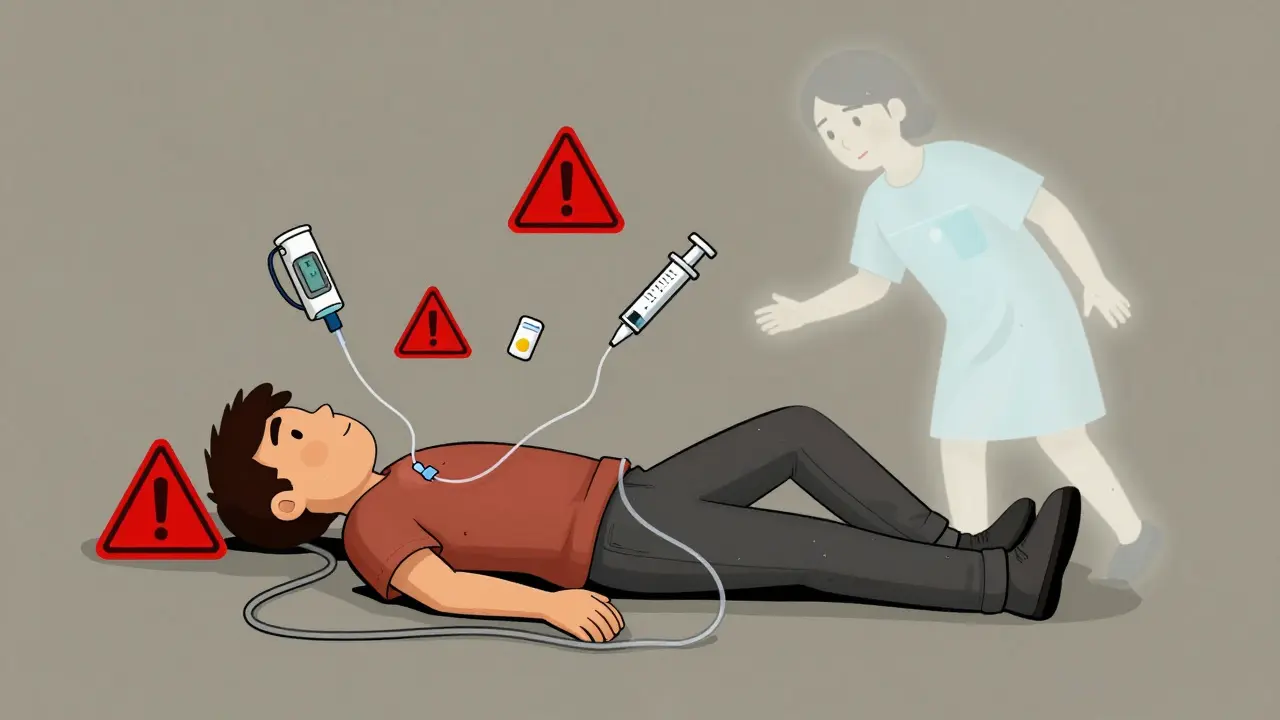
Here’s the hard truth: pumps don’t stop delivering insulin if you pass out. If you’re unconscious, the pump keeps going. That’s why people have died from unnoticed disconnections or incorrect settings. If you’re hypoglycemic and your pump is still running, remove the infusion set immediately. Treat the low with glucose. Then call your doctor. Don’t wait.
Before surgery, talk to your care team. For minor procedures where you’ll eat in 2-3 hours, you can keep the pump on-if your glucose is between 4-12 mmol/L and the site is accessible. For major surgery? Stop the pump. Switch to IV insulin. Your body needs control, not automation.
After childbirth, insulin needs drop fast. Breastfeeding can cut your requirements by 10-20% or more. If you don’t adjust, you’ll crash. One mother in Melbourne told me she went from 40 units a day to 18 within 48 hours of giving birth. Her pump didn’t auto-adjust. She had to manually reprogram it.
Training, Testing, and Long-Term Success
Getting a pump isn’t a one-day event. It’s a 3-6 month learning curve. Most providers require at least 15 hours of structured training before you get one. You need to know how to count carbs, interpret CGM trends, troubleshoot occlusions, and recognize alarm patterns. You also need to carry backup: extra insulin, syringes, batteries, glucose tabs, and infusion sets. Always. Even if you’ve had the pump for years.
Users who succeed with CSII are the ones who check their settings monthly, log their food and glucose, and test their basal rates regularly. Those who don’t? They end up with higher A1c, more hospital visits, and more stress. A 2023 study found 68% of users lowered their A1c by at least 0.5% within six months-but only if they followed up with their diabetes educator every 4-6 weeks.
The Future: Smarter Pumps, Bigger Challenges
The market is shifting. New pumps like the Tandem Mobi are smaller, lighter, and designed for kids. The Omnipod 5 works with multiple CGMs, not just one brand. Predictive low-glucose suspend is getting longer-some systems now pause insulin for up to 120 minutes. But the biggest leap? Bihormonal pumps that deliver both insulin and glucagon. They’re in trials. They could prevent lows without user input. But they’re not here yet.
Cost remains a barrier. In the U.S., pumps and supplies cost $6,500-$8,200 a year. In Australia, Medicare and private insurers cover most of it, but not all. If you’re considering CSII, check your coverage. Don’t assume it’s affordable.
How often should I change my infusion set?
Change your infusion set every 2-3 days. Leaving it in longer increases the risk of infection, poor insulin absorption, and lipohypertrophy. Some users stretch to 4 days, but that’s not recommended. Always rotate sites and check for redness, swelling, or pain.
Can I swim or shower with my insulin pump?
Most modern pumps are water-resistant but not waterproof. You can swim or shower if you disconnect the pump temporarily. Some models, like the Omnipod, are fully waterproof and can stay on. Always check your pump’s manual. If you disconnect, have a backup plan-use a syringe or pen to replace basal insulin if you’re away longer than 1 hour.
What should I do if my pump stops working?
If your pump stops, immediately switch to insulin injections using a syringe or pen. Give your basal insulin as you normally would (use your total daily basal dose). Monitor your blood sugar every 2-3 hours. If your glucose rises above 14 mmol/L, check for ketones. If ketones are present, seek medical help. Never wait more than 4 hours without insulin.
Do I still need to check my blood sugar if I have a CGM?
Yes. CGMs are excellent, but they can be wrong. Calibrate them twice a day if required. Always confirm with a fingerstick if your CGM shows a sudden drop or if you feel symptoms of low blood sugar. Don’t trust the screen blindly. Real glucose testing is still the gold standard.
Is CSII better than multiple daily injections?
It depends. CSII offers more flexibility, better A1c control, and fewer lows for many users-especially those with unpredictable schedules or frequent highs and lows. But it requires more work: constant monitoring, carb counting, and troubleshooting. If you’re not willing to do that, MDI might be safer and simpler. CSII isn’t for everyone. It’s for those ready to take full control.
Final Thought: It’s Not Magic. It’s Management.
An insulin pump doesn’t cure diabetes. It doesn’t think for you. It doesn’t replace your brain. It just delivers insulin-precisely, when you tell it to. Success comes from discipline: testing your settings, changing your site, carrying backups, and never assuming everything’s fine. The best pump users aren’t the tech-savviest. They’re the most consistent. The ones who log their numbers. The ones who ask questions. The ones who don’t ignore the alarm. That’s how you stay safe. That’s how you live well.