
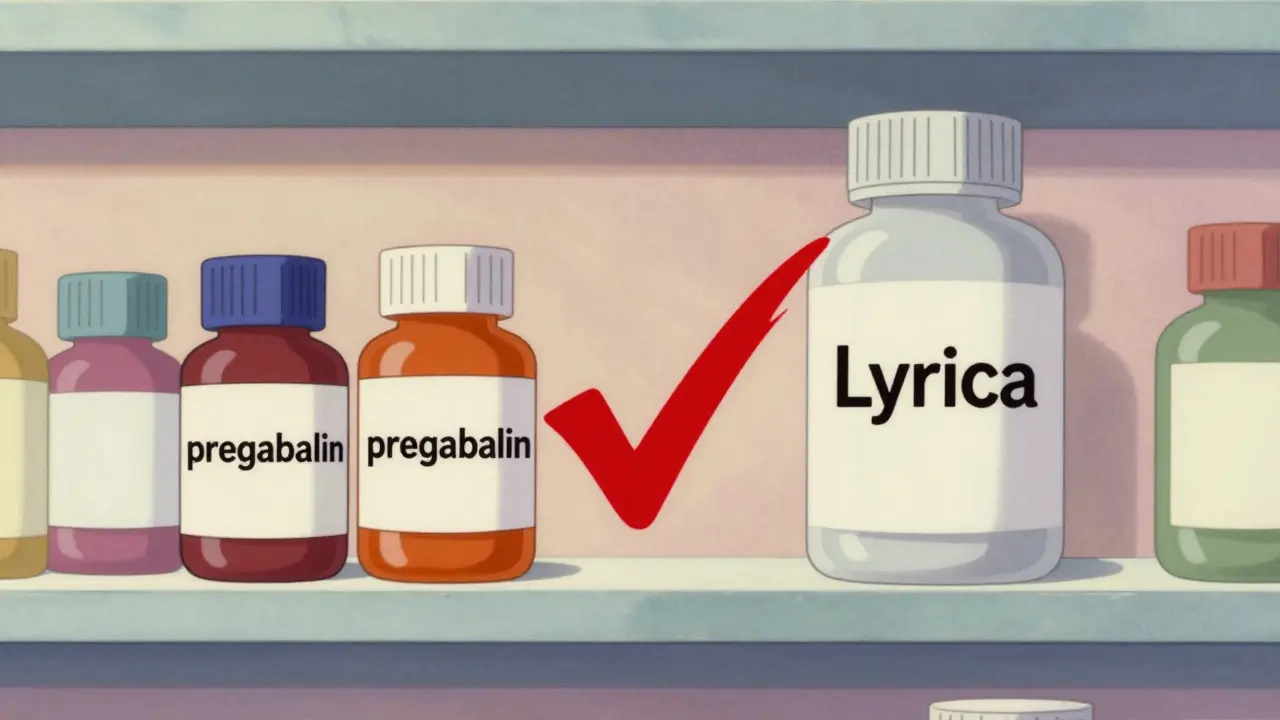
When you pick up a prescription at the pharmacy and see a brand-name drug like Lyrica replaced with a much cheaper version labeled pregabalin, you’re seeing the result of something called an Abbreviated New Drug Application - or ANDA. It’s the secret engine behind most generic drugs in the U.S., saving billions every year without sacrificing safety or effectiveness. But what exactly is an ANDA? And why does it matter to you?
What an ANDA Actually Is
An ANDA is a formal request submitted to the U.S. Food and Drug Administration (FDA) to get approval to sell a generic version of a brand-name drug. Unlike the original drug maker, who had to prove the drug was safe and effective from scratch, a generic company doesn’t need to repeat all those expensive clinical trials. Instead, they prove their version is the same in every way that matters - active ingredient, strength, how it’s taken, and how the body absorbs it.
The term “abbreviated” isn’t just a fancy word. It means the process skips the long, costly steps of testing safety and effectiveness on humans and animals. That’s because the original drug - called the Reference Listed Drug (RLD) - already did that. The FDA approved it years ago. The ANDA applicant just has to show their version matches it exactly in performance.
This system started in 1984 with the Hatch-Waxman Act. Before that, generic drugs faced huge legal and scientific barriers. After the law passed, generic drug approvals exploded. By 2023, over 11,000 generic drugs had been approved through ANDAs. Today, about 9 out of 10 prescriptions filled in the U.S. are for generics.
How an ANDA Works: The Core Requirements
To get an ANDA approved, the applicant must prove four things:
- Same active ingredient - The generic must contain the exact same medicine as the brand-name drug. No more, no less.
- Same dosage form - If the original is a tablet, the generic must be a tablet. If it’s an injection, the generic must be an injection.
- Same strength and route - A 10mg pill must be 10mg. A pill taken by mouth must be taken by mouth. No changes allowed.
- Same conditions of use - It must be used for the same medical conditions as the original.
That’s the easy part. The real test is bioequivalence.
Bioequivalence means the generic drug gets into your bloodstream at the same rate and to the same level as the brand-name drug. To prove this, companies run studies with 24 to 36 healthy volunteers. They give half the group the brand-name drug and half the generic, then measure how much of the drug shows up in the blood over time.
The FDA requires the results to fall within 80% to 125% of the brand-name drug’s numbers for two key measurements: how much of the drug is absorbed overall (AUC) and how fast it reaches peak concentration (Cmax). If it’s outside that range, the FDA won’t approve it.
This isn’t a guess. It’s science. And it works. Studies show generic drugs approved through ANDAs are just as effective and safe as their brand-name counterparts - with a 97% therapeutic equivalence rate.
What’s Allowed to Be Different
Even though the active ingredient and how it works must be identical, some things can be different:
- Inactive ingredients - Fillers, dyes, flavors, or preservatives can change. That’s why some generics might look different or taste different. But these can’t affect how the drug works.
- Packaging - The bottle, blister pack, or label design can be different. The generic won’t have the same logo or brand name.
- Labeling - The patient information leaflet must match the brand’s, except for the company name and logo.
These small differences are why some people say a generic “feels different.” But it’s rarely the medicine itself. It’s the coating on the pill, the size, or even the placebo effect.
ANDA vs. NDA: The Big Difference
Every new drug starts with a New Drug Application, or NDA. That’s what Pfizer or Merck files when they invent a brand-new medicine. An NDA can take 10 to 15 years and cost over $2.6 billion. It includes animal studies, dozens of clinical trials, and years of safety monitoring.
An ANDA? It’s a fraction of that.
Typically, an ANDA takes 3 to 4 years and costs between $1 million and $5 million. The FDA reviews it in about 10 months under current rules. That speed and low cost are why generic drugs exist at all.
Without the ANDA pathway, most people couldn’t afford their prescriptions. The average brand-name drug costs 10 to 20 times more than its generic version. After a generic enters the market, prices drop by 80% to 85% within a year.
Who Files ANDAs and Why It Matters
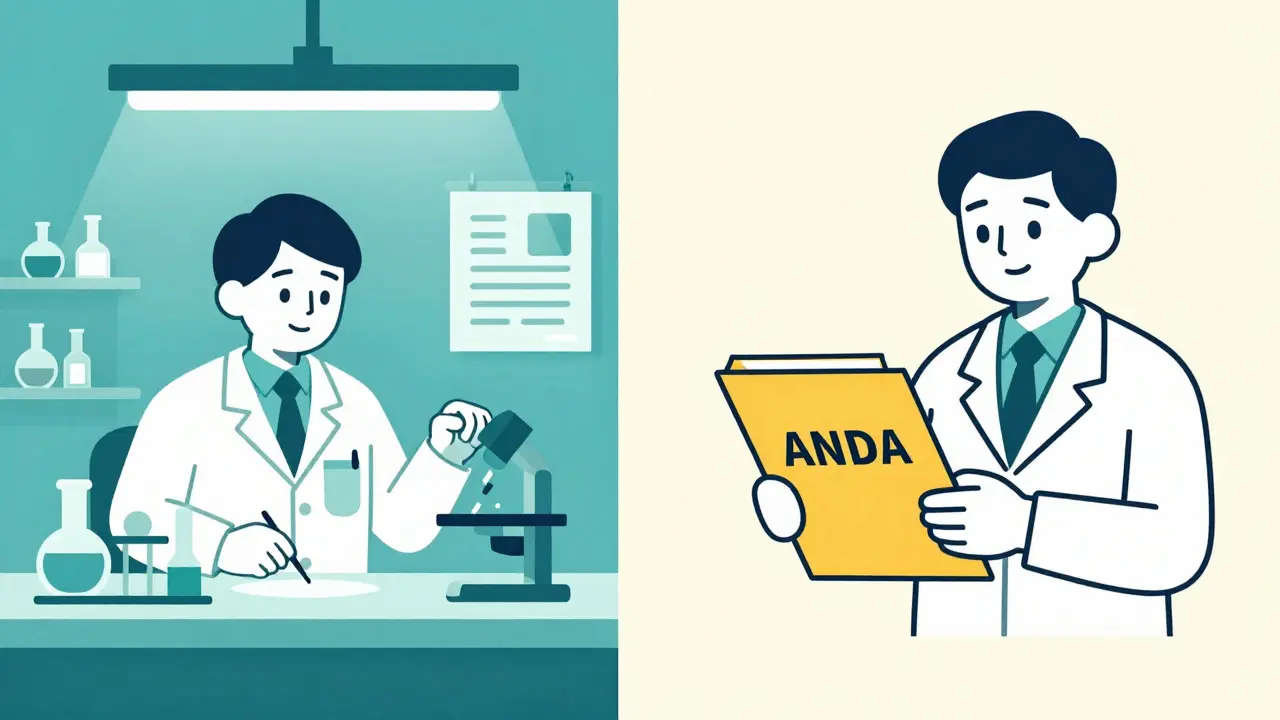
ANDAs are filed by generic drug manufacturers - companies like Teva, Mylan (now Viatris), Sandoz, and hundreds of smaller firms. These companies don’t invent new drugs. They make existing ones cheaper.
There’s a financial incentive built into the system. The first company to file an ANDA and successfully challenge a patent gets 180 days of exclusive rights to sell that generic. That’s why you often see two or three generics hit the market at once - they’re racing to be first.
This competition drives prices down. In 2022 alone, 724 new generic drugs were approved, with the potential to save the U.S. healthcare system $23.7 billion in a single year. Over the past decade, generic drugs have saved the system over $2.2 trillion.
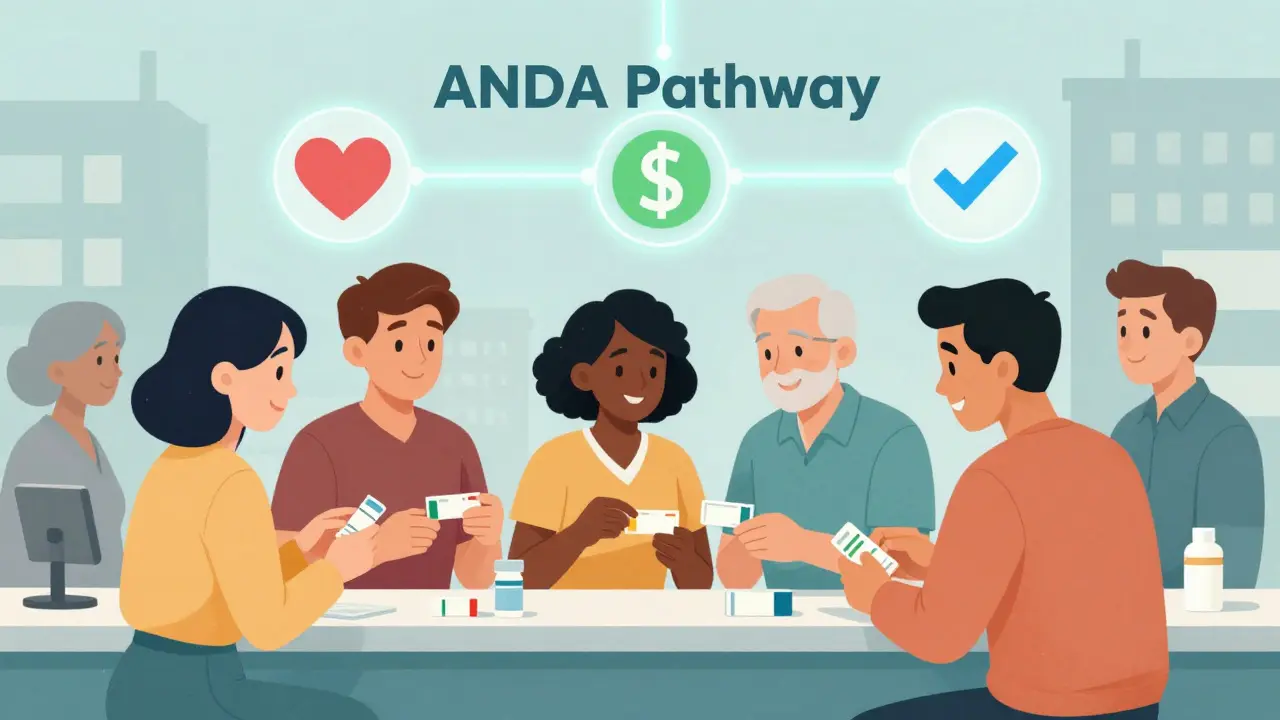
And it’s not just about money. It’s about access. A patient with diabetes, high blood pressure, or asthma can stick to their treatment plan because the generic version is affordable. Without ANDAs, many people would skip doses or stop taking their meds altogether.
Where the System Gets Complicated
For simple pills and capsules, the ANDA process works smoothly. But for complex drugs - like inhalers, topical creams, or injectables - things get messy.
Why? Because you can’t always measure how well they work just by checking blood levels. For example, with an asthma inhaler, the drug needs to reach the lungs. But the device’s design, spray pattern, and particle size matter just as much as the medicine. The FDA has struggled to create reliable tests for these kinds of drugs.
As a result, many complex generics get rejected. A 2022 FDA report found that 32% of ANDA rejections were due to manufacturing issues, and 27% were because bioequivalence data was unclear or incomplete.
Smaller companies often struggle with these hurdles. One survey found that 68% of generic manufacturers had trouble proving bioequivalence for complex products. They get what’s called a “complete response letter” - basically, a detailed list of what’s wrong with their application. Fixing it can take months or even years.
The FDA is trying to fix this. In 2022, they launched a new program specifically for complex generics. And under the 2023 GDUFA IV rules, they aim to raise the first-time approval rate from 65% to 90% by 2027.
What Happens After Approval
Once an ANDA is approved, the FDA assigns it a unique six-digit number - like ANDA 214,455 for the generic version of Eliquis. That number stays with the product forever.
Manufacturers must still follow strict rules. The FDA inspects their factories regularly. If they change the process, they must notify the FDA. If the drug causes unexpected side effects, they have to report them.
And if a patent expires or is challenged, the generic can start selling immediately. That’s why you’ll often see multiple generic versions of the same drug appear on shelves at the same time.
Why You Should Trust Generic Drugs
There’s a myth that generics are “weaker” or “inferior.” That’s not true. The FDA requires them to meet the same quality standards as brand-name drugs. In fact, many brand-name companies make their own generics after the patent expires.
Think about it: if a generic didn’t work, people would notice. Patients would report it. Doctors would stop prescribing it. But they don’t. Studies show that 97% of patients on generics report the same results as they did on the brand-name version.
And if you’re worried about where the drug is made - most generic drugs, including brand-name ones, are manufactured overseas. The FDA inspects factories in India, China, and elsewhere just like it does in the U.S. If a facility fails inspection, the FDA blocks the drug from entering the country.
The Bigger Picture
The ANDA system isn’t perfect. There are supply chain risks. Some critical drugs have been in short supply because they’re made in just one factory overseas. And some complex drugs still take too long to get approved.
But overall, it’s one of the most successful public health policies in modern history. It balances innovation with affordability. It rewards companies that make drugs cheaper without letting safety slide.
For you, it means you can get the medicine you need without going broke. For the system, it means billions saved every year. For patients, it means better health outcomes.
Next time you see a generic drug on your prescription, know this: it’s not a compromise. It’s the result of a smart, science-based system that works.
Is an ANDA the same as a generic drug?
No. An ANDA is the application submitted to the FDA to get approval for a generic drug. The generic drug is the actual product you get at the pharmacy. The ANDA is the paperwork that proves the generic is safe and effective.
Do generic drugs work as well as brand-name drugs?
Yes. The FDA requires generic drugs to be bioequivalent to their brand-name counterparts, meaning they deliver the same amount of medicine into your bloodstream at the same rate. Studies show 97% of patients experience the same results with generics as they did with the brand-name version.
Why are generic drugs cheaper?
Generic drugs don’t require expensive clinical trials because they rely on the safety and effectiveness data of the original brand-name drug. The ANDA process cuts development time from 10-15 years to 3-4 years and reduces costs from over $2 billion to $1-5 million per product.
Can any drug be made into a generic?
No. Only drugs whose patents have expired and that meet specific criteria can be approved as generics. Complex drugs like inhalers, biologics, or those with narrow therapeutic windows often can’t use the standard ANDA pathway and require special review.
How long does it take to get an ANDA approved?
Under current FDA rules, the review time for a standard ANDA is 10 months. However, if the application has issues - like incomplete data or manufacturing concerns - the FDA may issue a complete response letter, which can delay approval by months or even years.
Are generic drugs made in the same facilities as brand-name drugs?
Sometimes. Many brand-name companies also produce generic versions of their own drugs after the patent expires. Others are made in independent factories, often overseas. The FDA inspects all facilities - whether in the U.S., India, or China - using the same standards. If a factory fails inspection, the drug can’t be sold.
What Comes Next
If you’re a patient, keep taking your generics. They’re safe, effective, and affordable.
If you’re a manufacturer, focus on quality and compliance. The FDA’s new rules are pushing for higher first-time approval rates. That means better-prepared applications will get through faster.
If you’re just curious - remember this: every time you choose a generic, you’re not just saving money. You’re supporting a system that makes healthcare more accessible for millions of people.



Comments (14)