Topical Steroid Safety Calculator
How to Use This Tool
Enter your steroid details below to get personalized safety recommendations. This tool uses evidence-based guidelines to help you avoid skin damage from improper steroid use.
Using topical steroids correctly isn’t just about clearing a rash-it’s about avoiding damage you can’t see until it’s too late. Skin thinning, redness, stretch marks, and even systemic effects like adrenal suppression don’t happen overnight. They creep in when people use the wrong strength, on the wrong part of the body, for too long. And the biggest problem? Most patients don’t know what strength they’re using. A 2022 survey by the National Eczema Association found that 78% of patients couldn’t identify their steroid’s potency class without help. That’s not just a knowledge gap-it’s a safety risk.
How Potency Classes Actually Work
Topical steroids aren’t all created equal. They’re grouped into potency classes based on how strongly they shrink blood vessels in the skin-a test called the vasoconstrictor assay. This isn’t guesswork. It’s science. The U.S. FDA uses a seven-class system, where Class I is the strongest and Class VII is the weakest. Class I includes drugs like clobetasol propionate (Temovate) and halobetasol (Ultravate). These are powerful. They work fast on thick, stubborn plaques like in psoriasis. But they can thin your skin in weeks if used on the face or groin.
On the other end, Class VII includes hydrocortisone 0.5% to 2.5%. You’ll find this in over-the-counter creams like Cortizone-10. It’s mild enough for babies and sensitive areas. But here’s the catch: potency doesn’t just depend on the drug. It also depends on the base. An ointment locks in moisture and lets more steroid soak into your skin. A cream? Less absorption. A foam? Even more. A 2022 study in the Journal of the American Academy of Dermatology showed ointments increase absorption by 15-20% compared to creams. That means the same strength steroid in an ointment can act like a class higher.
Why Location Matters More Than You Think
Applying a potent steroid to your eyelids? That’s asking for trouble. Skin on the face, neck, armpits, and groin is up to 10 times thinner than skin on your back or legs. A 2020 study in the Dermatology Patient Registry found that 42% of patients used moderate-to-high potency steroids on their face-increasing the risk of side effects fourfold. That’s why guidelines are so clear: only use mild steroids (Class VI-VII) on the face. Even then, limit use to 5-7 days.
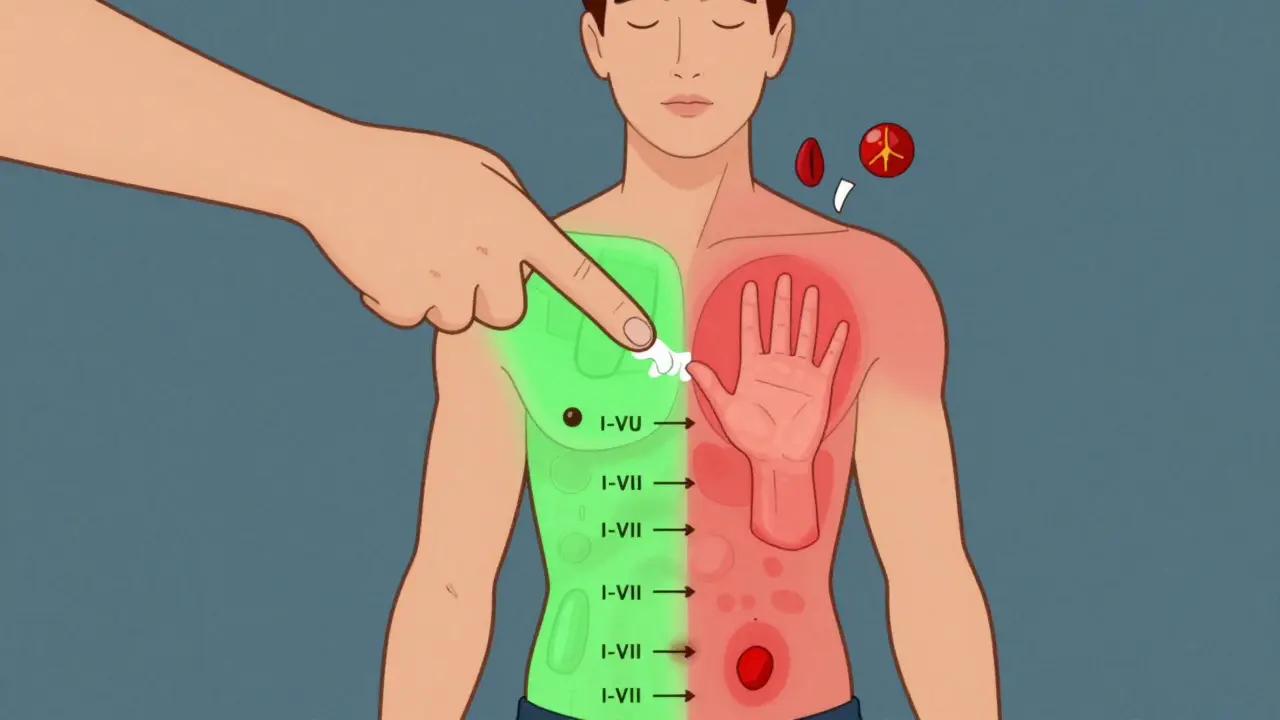
But here’s something most charts don’t tell you: the same steroid becomes stronger when applied to skin folds. The Skin Health Institute of Australia updated their 2023 chart to show that potency effectively increases by one class in areas like the armpits, groin, or under the breasts. So if your doctor prescribed a Class IV steroid for your eczema on your arm, it’s like using Class V if you apply it to your inner thigh. That’s not a mistake-it’s physics. Thinner skin = more absorption. More absorption = higher risk.
The Real Numbers Behind Side Effects
Let’s talk numbers. A 2021 meta-analysis of 14 clinical trials showed that 29% of patients using Class I steroids for more than three weeks developed skin atrophy. That’s not rare. That’s predictable. And it’s not just about visible thinning. Blood vessels can become permanently dilated-telangiectasia-happening in 12% of people using Class II-III steroids for over three months. These aren’t rare side effects. They’re expected outcomes of misuse.
And it’s not just skin. Kids are especially vulnerable. Their skin absorbs more, and their bodies are smaller. Dr. Lawrence Eichenfield’s 2021 study in Pediatrics found that children have 3-5 times higher systemic absorption than adults. That’s why the American Academy of Pediatrics recommends cutting adult doses by 50-75% and limiting treatment to 7-14 days for moderate steroids in kids. A 2020 registry found 8.7% of children improperly treated with high-potency steroids showed signs of HPA axis suppression-affecting how their body handles stress. That’s serious.

How Much Should You Really Use?
Most people use too much. A 2022 study from the University of California found 35% of patients applied 2-3 times the recommended amount. The solution? The fingertip unit (FTU). One FTU is the amount of cream squeezed from a tube that covers the distance from the tip of your finger to the first crease. One FTU covers two adult palms. For most adults, that’s enough for the entire front of one leg.
Frequency matters too. Mild steroids (Class VI-VII) can be used twice daily for up to four weeks. Moderate (Class IV-V)? Once a day for one to two weeks. Potent (Class II-III)? Once a day for three to seven days. Superpotent (Class I)? No more than seven days unless under strict supervision. Pushing beyond those limits doesn’t make it work better-it just makes side effects worse.
What About Kids and Long-Term Use?
Parents often think, “If it works, why stop?” But stopping isn’t about giving up-it’s about preventing damage. Proactive therapy is the smarter move. The 2021 TRAIN study, published in the British Journal of Dermatology, showed that applying a mild steroid twice a week to previously affected areas cut eczema flares by 68% over 16 weeks. That’s not treating a flare. That’s preventing one. It’s like brushing your teeth to avoid cavities-not waiting until you have a toothache.
For kids, this approach is even more critical. Instead of using steroids every time the skin gets red, use them once or twice a week on areas that flare often. Keep the rest of the skin moisturized. This reduces steroid exposure, lowers the risk of side effects, and keeps flares under control. The National Eczema Society now recommends this as standard care.

What’s New in 2026?
Things are changing. In 2023, the American Academy of Dermatology rolled out Version 2.1 of their digital potency tool. It doesn’t just list classes-it uses AI to adjust recommendations based on age, skin site, previous response, and even weather. In a trial of 1,247 patients, it cut prescribing errors by 32%. That’s huge.
Also, newer non-steroidal options like crisaborole (Eucrisa) and ruxolitinib (Opzelura) are now part of the conversation. The National Psoriasis Foundation updated their chart in January 2023 to show that while superpotent steroids clear 85% of psoriasis plaques in four weeks, ruxolitinib clears 72%. That’s close. And without the risk of skin thinning. For many patients, switching to these after short steroid bursts is the smarter long-term move.
And the future? Wearable sensors that measure transepidermal water loss (TEWL) are being tested. Imagine a patch that tells you your skin barrier is weakening-and automatically suggests lowering your steroid strength. Pilot programs started in late 2023. This isn’t sci-fi. It’s coming.
What You Should Do Today
Check your steroid. Look at the label. Is it listed as Class I, II, or III? If you’re not sure, ask your pharmacist. They’ve seen the new FDA labeling requirements since 2023-every prescription now has the potency class printed on it.
Use the FTU method. Don’t smear. Don’t pile it on. One FTU per two palms. That’s enough.
Never use potent steroids on your face, eyelids, or genitals unless your doctor says so-and even then, limit it to 5-7 days.
For kids, always reduce the dose. Always limit the time. Always use mild steroids for maintenance.
And if you’ve been using a strong steroid for more than three weeks? Talk to your doctor. Don’t stop suddenly. But don’t keep going either. There are safer ways to manage chronic skin conditions now.
Can I use a strong steroid on my face if I only use it for a few days?
Even short-term use of high-potency steroids on the face can cause skin thinning, redness, and visible blood vessels. The skin on the face is much thinner than on other parts of the body. Most guidelines recommend only mild steroids (Class VI-VII) for facial use, even for brief periods. If you need stronger treatment, your doctor should prescribe a specific short-term plan and monitor you closely.
Why does my doctor say not to use steroid cream every day?
Daily use of moderate or strong steroids for more than two weeks increases the risk of skin atrophy, stretch marks, and even systemic absorption. The body doesn’t need constant suppression of inflammation. Once the flare is under control, switching to moisturizers or mild steroids twice a week (proactive therapy) is safer and just as effective at preventing recurrence. Continuous use doesn’t mean better results-it means more side effects.
Is hydrocortisone 2.5% stronger than hydrocortisone 1%?
Yes, but not by much. Both are in Class VII (least potent). The difference in strength is small, and the main reason to use 2.5% is for thicker, more stubborn areas like the palms or soles. For most skin, 1% is just as effective with less risk. Using 2.5% on the face or in children doesn’t give better results-it just increases side effect risk.
Are over-the-counter steroids safe for long-term use?
Most OTC steroids are mild (Class VII), like hydrocortisone 1%. These are generally safe for short-term use (up to 2 weeks). But using them daily for months, even at low strength, can still cause skin thinning, especially on sensitive areas. They’re not meant for chronic, daily maintenance. If you need daily treatment, talk to your doctor about non-steroidal options or proactive steroid scheduling.
What’s the difference between a cream and an ointment?
Ointments are greasier and trap moisture better, which lets more steroid penetrate the skin. That means an ointment can act like a potency class higher than the same steroid in a cream. For dry, thick skin, ointments work better. For weepy, inflamed skin or sensitive areas, creams are less irritating. The base changes how the drug works-even if the active ingredient is the same.
Topical steroids are powerful tools. But like any tool, they’re dangerous in untrained hands. The potency chart isn’t just a reference-it’s your safety guide. Know your class. Know your area. Know your dose. And don’t be afraid to ask your doctor: "Is this the right strength?" Because the right answer isn’t always the strongest one.