
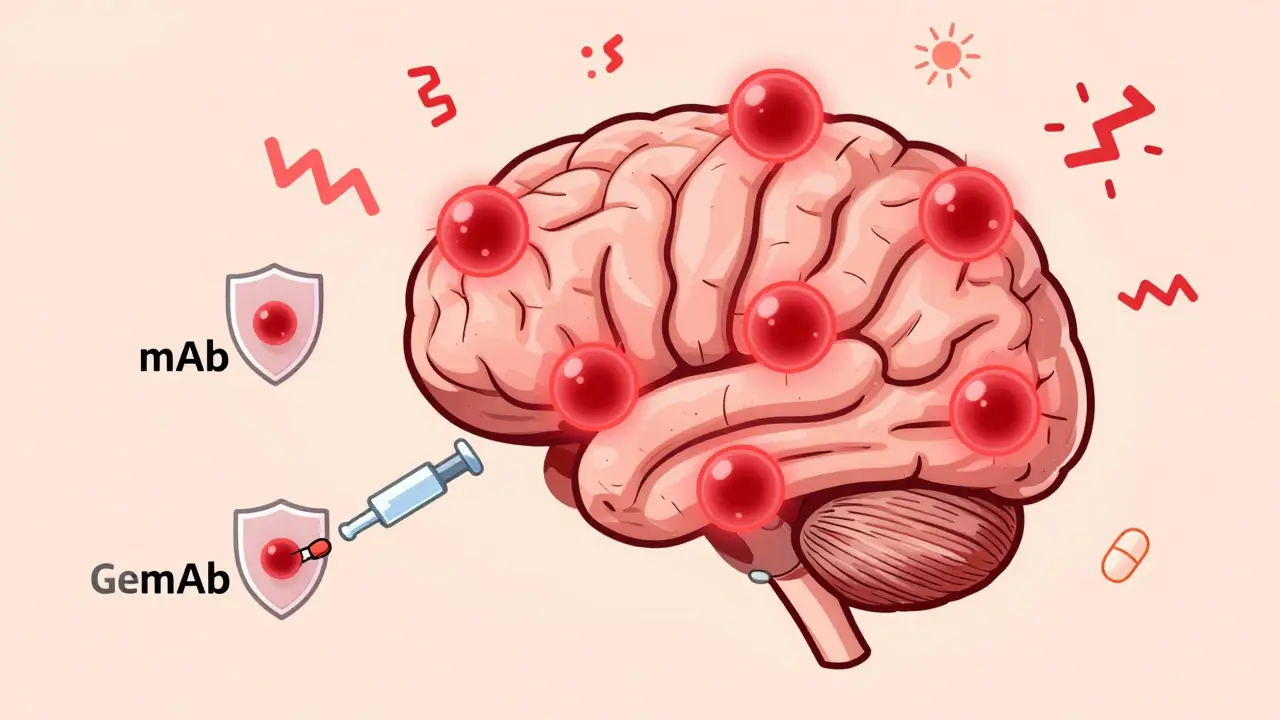
Before 2018, if you had migraines, your doctor had limited options. They’d prescribe you blood pressure pills, seizure meds, or antidepressants-drugs never meant for headaches. These worked for some, but often came with drowsiness, weight gain, or worse side effects. Then came something different: medications built only for migraine. That’s the story of CGRP inhibitors.
What Exactly Are CGRP Inhibitors?
CGRP stands for Calcitonin Gene-Related Peptide. It’s a tiny protein in your brain that gets released during a migraine attack. When it’s active, it triggers pain signals and swells blood vessels around your brain. That’s part of why migraines hurt so badly and last so long.
CGRP inhibitors block this protein. Some versions lock onto the CGRP molecule itself. Others stick to its receptor-the spot where CGRP normally attaches. Either way, they stop the signal before it starts. This isn’t just another drug. It’s the first class of migraine medicine designed from the ground up to target the root cause, not just mask symptoms.
Two Types of CGRP Inhibitors
There are two main kinds: monoclonal antibodies (mAbs) and gepants.
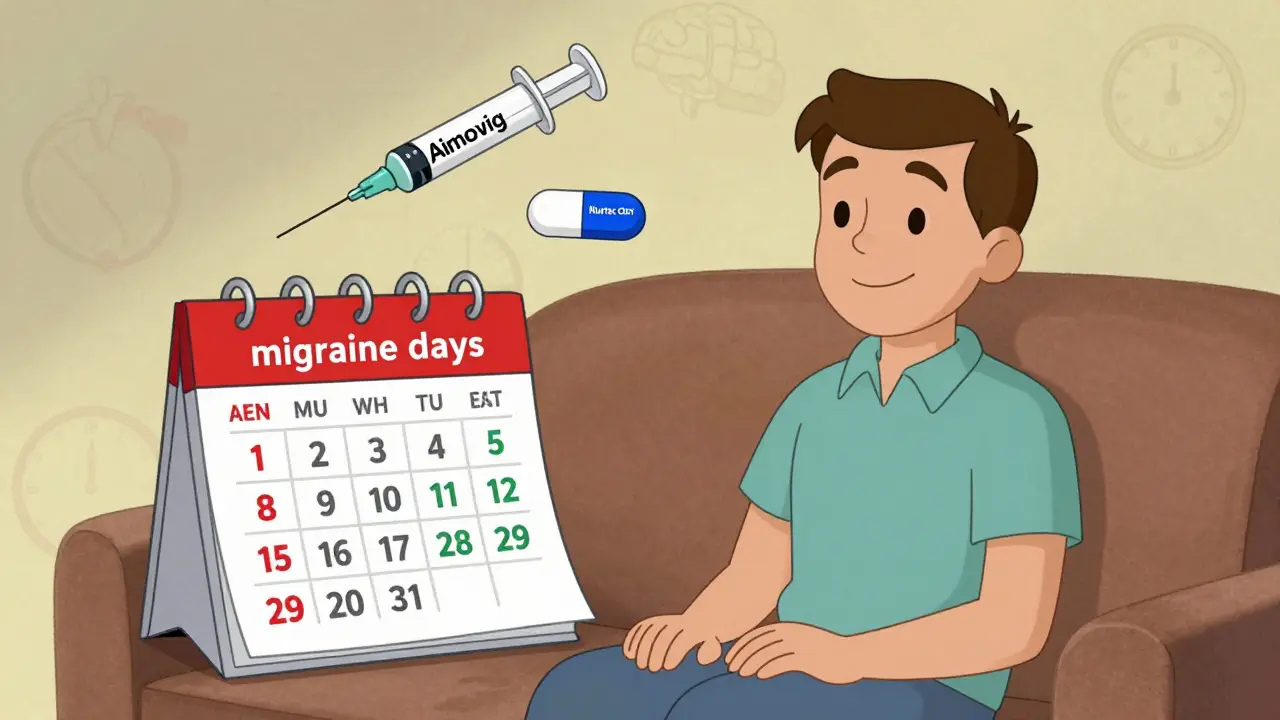
Monoclonal antibodies like Aimovig (erenumab), Ajovy (fremanezumab), Emgality (galcanezumab), and Vyvgart (eptinezumab) are injected. You get them once a month-or even once every three months. They’re meant for prevention. They don’t stop a migraine once it’s started, but they cut down how often they happen.
Gepants like Nurtec ODT (rimegepant), Ubrelvy (ubrogepant), and Zavzpret (zavegepant) are small molecules you take as pills or nasal sprays. The big shift? Some of them, like Nurtec ODT, work for both preventing and treating migraines. You can take them every other day to cut down attacks-or pop one when you feel a migraine coming on.
How Well Do They Actually Work?
Real numbers matter. In clinical trials, about half of people using CGRP inhibitors cut their migraine days in half. For someone who had eight migraine days a month? They often drop to four or fewer.
Chronic migraine patients-those with 15 or more headache days a month-see even bigger wins. One study showed 84.3% of them had fewer headache days. And here’s the kicker: 41% of chronic patients went from having daily pain to only occasional attacks. That’s not just relief. That’s life-changing.
Compared to older drugs like topiramate or propranolol, CGRP inhibitors win. A direct head-to-head trial found 40.7% of people on Aimovig cut their migraine days by half, while only 23.8% did on topiramate. And side effects? Much gentler. No brain fog. No weight gain. No tremors. Just fewer headaches.
Who Benefits the Most?
These drugs aren’t for everyone. But they’re especially powerful for:
- People who’ve tried at least two other preventives and failed
- Those with medication-overuse headache (taking painkillers too often)
- Patients with heart disease or high blood pressure (since CGRP inhibitors don’t narrow blood vessels like triptans do)
- People with aura-those visual disturbances before a migraine
They’re less effective if you only get migraines two or three times a month. But if you’re stuck in a cycle of frequent, disabling attacks? This is where they shine.
Side Effects and Risks
Most people tolerate them well. The most common side effect? Injection site redness or pain for the monthly shots. About 1 in 4 people report this. It’s mild and goes away.
For gepants, there’s a small risk of liver enzyme changes. That’s why your doctor might check your liver function every few months if you’re on ubrogepant or rimegepant long-term. It’s rare, but it’s monitored.
One concern? Long-term safety beyond five years. We don’t have data yet. But so far, no major red flags. Less than 1% of people stop these drugs because of side effects.

Cost and Access
Yes, they’re expensive. Monthly costs range from $650 to $1,000. That’s 3 to 5 times more than generic preventives like propranolol.
But here’s the reality: most U.S. insurance plans cover them-with a few steps. You’ll likely need prior authorization. Some insurers make you try cheaper drugs first. But manufacturers have patient support programs that cover up to 80% of out-of-pocket costs. If you’re eligible, your monthly bill could drop to under $50.
And the cost? Many patients say it’s worth it. One woman on Drugs.com wrote: “After 15 years of chronic migraine, Emgality got me down to episodic in 3 months. Life-changing.” That’s not an outlier. In a survey of over 1,200 users, 78% called CGRP inhibitors “very effective” or “effective.”
What’s Next?
The field is moving fast. Researchers are testing:
- Combining CGRP inhibitors with Botox-for people with severe, stubborn migraines
- Nasal and skin-patch versions to avoid injections
- Formulas for teens and children (phase 3 trials finished in early 2023)
- Use for vestibular migraine (dizziness with headaches) and post-head injury headaches
By 2028, we might see biosimilars hit the market. That could cut prices. For now, though, the four mAbs and three gepants dominate.
Why This Matters
Migraine isn’t just a headache. It’s a neurological disease that steals time, jobs, and relationships. For decades, people were told to “just live with it.” Now, for the first time, we have tools that don’t just numb the pain-they change the disease itself.
Neurologists are shifting their approach. The American Headache Society now says CGRP inhibitors should be a first-line option-not a last resort. That’s huge. It means if you’re struggling, you don’t have to waste years on ineffective drugs anymore.
If you’ve been stuck in the migraine cycle, this isn’t magic. But it’s science. And it’s working.
Are CGRP inhibitors safe for people with heart problems?
Yes. Unlike triptans or ergotamines, CGRP inhibitors don’t narrow blood vessels. That makes them safer for people with heart disease, high blood pressure, or a history of stroke. In fact, they’re often preferred for these patients because older migraine drugs carry higher risks.
Can I take CGRP inhibitors with other migraine meds?
Most can be safely combined. For example, you can use a gepant like Nurtec ODT for acute attacks while taking a monoclonal antibody like Aimovig for prevention. Some patients also use Botox alongside CGRP inhibitors for extra control. Always check with your doctor-especially if you’re on liver-metabolized drugs.
How long until I see results?
Most people notice improvement within 1 to 3 months. Some feel better in the first month. For chronic migraine patients, the biggest drop in frequency often happens between months 2 and 4. Don’t give up if you don’t see results right away-it can take time.
Do I have to keep taking them forever?
Not necessarily. Some patients stay on them long-term because their migraines return if they stop. Others, especially those who went from chronic to episodic, may be able to taper off after 6-12 months with their doctor’s guidance. It depends on your individual response and migraine pattern.
Are there any alternatives if I can’t afford CGRP inhibitors?
Yes. Generic options like propranolol, topiramate, or amitriptyline are still used, especially if insurance doesn’t cover CGRP drugs. But if you’ve tried those and they didn’t work-or had too many side effects-CGRP inhibitors are worth pursuing. Manufacturer assistance programs can reduce costs significantly, and some clinics offer payment plans.




Comments (9)