
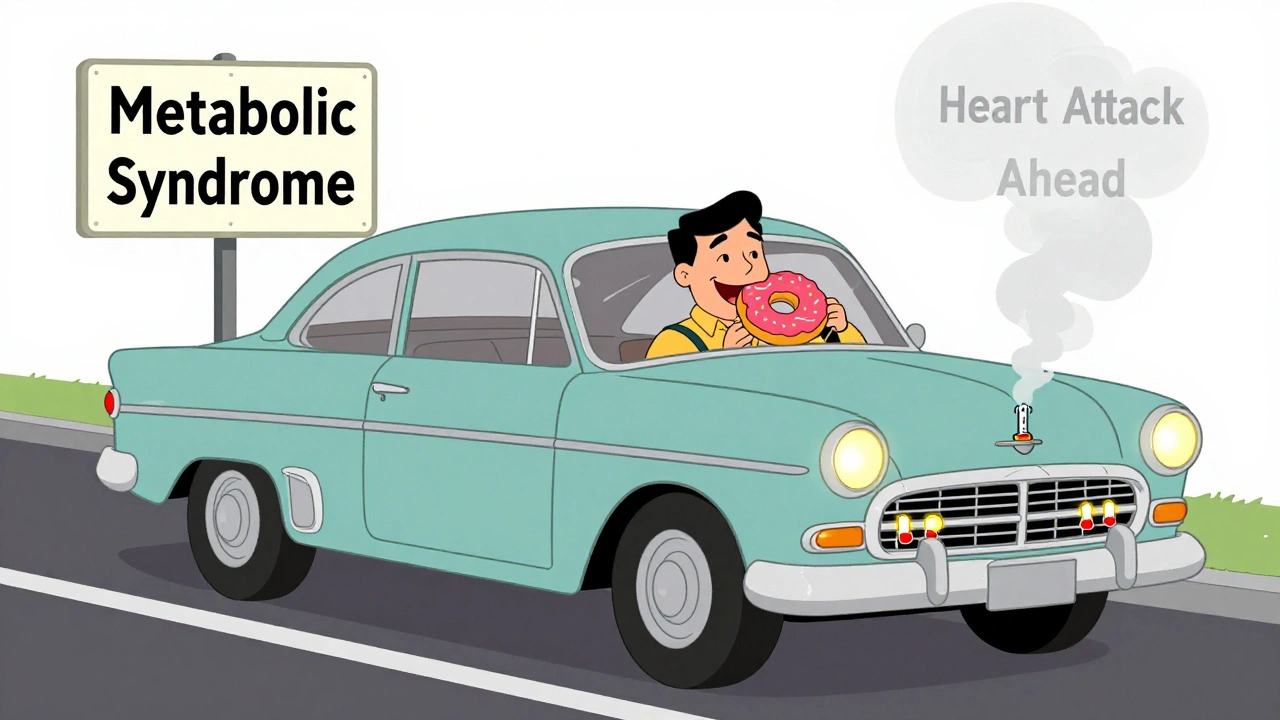
Imagine your body is a car. One warning light on the dashboard might be annoying, but if five lights come on at once-oil pressure, temperature, battery, brake, and engine check-you don’t just ignore one. You pull over. That’s what metabolic syndrome is: five warning lights flashing at once, telling you your body is in serious trouble. And the biggest danger? It’s quietly setting you up for a heart attack or stroke before you even feel sick.
What Exactly Is Metabolic Syndrome?
Metabolic syndrome isn’t one disease. It’s a group of five health problems that often happen together. You don’t need all five to be in danger-but if you have three or more, your risk of heart disease jumps by 1.5 to 2 times, and your chance of getting type 2 diabetes goes up fivefold. The American Heart Association and the National Heart, Lung, and Blood Institute set the official criteria back in 2005, and they haven’t changed much since. Here’s what they are:- Abdominal obesity: Waist size over 40 inches (102 cm) for men, or 35 inches (88 cm) for women. For Asian populations, the thresholds are lower-35 inches for men and 31 inches for women-because fat around the belly is more dangerous at smaller sizes.
- High triglycerides: 150 mg/dL or higher. This is the fat in your blood that comes from eating too many carbs and sugars.
- Low HDL cholesterol: Under 40 mg/dL for men, under 50 mg/dL for women. HDL is the "good" cholesterol that helps clean out your arteries.
- High blood pressure: 130/85 mmHg or higher. Even if you only have one number high, it counts.
- High fasting blood sugar: 100 mg/dL or higher. This is your blood sugar after not eating for at least 8 hours.
Here’s the catch: you can have all these things and still feel fine. No chest pain. No dizziness. No symptoms at all. That’s why metabolic syndrome is called a silent killer. By the time someone feels sick, the damage is already done.
Why Does This Happen? The Role of Insulin Resistance
At the heart of metabolic syndrome is something called insulin resistance. Your body uses insulin to move sugar from your blood into your cells for energy. But when you eat too much sugar and refined carbs over years, your cells start to ignore insulin. It’s like your body’s lock is jammed-the key (insulin) still turns, but the door won’t open.So your pancreas pumps out more insulin to compensate. This extra insulin doesn’t just raise blood sugar-it also triggers fat storage, especially around your belly. It raises blood pressure. It lowers good cholesterol. It makes triglycerides climb. All of this happens at the same time because insulin is the common thread.
Dr. Scott M. Grundy, who led the team that first defined the diagnostic criteria, called insulin resistance the "common soil" from which all these problems grow. That’s why treating just one piece-like taking a pill for high blood pressure-doesn’t fix the root issue. The whole system is broken.
Who’s at Risk? The Numbers Don’t Lie
About 35% of U.S. adults have metabolic syndrome. That’s over 86 million people. And it’s not just older people. While only 20% of adults aged 20-39 have it, that number jumps to 47% for those over 60. But the real alarm is how fast it’s growing. Since 2000, the rate of abdominal obesity alone has climbed from 46% to nearly 60% in American adults.It’s not evenly spread. Hispanics have the highest rate at 38.6%, followed by non-Hispanic whites at 34.2%. Non-Hispanic Blacks are at 31.8%, and non-Hispanic Asians at 23.5%. But here’s something important: Asians develop metabolic syndrome at lower waist sizes than other groups. That’s why guidelines are stricter for them.
And it’s not just the U.S. The Global Burden of Disease Study predicts that by 2030, 40% of the world’s adults will have metabolic syndrome-with the biggest increases happening in South Asia and Latin America. This isn’t a Western problem anymore. It’s a global emergency.

Why Most Doctors Miss It
Here’s the frustrating part: many people with metabolic syndrome are never diagnosed. A 2022 survey on HealthUnlocked found that 68% of users had multiple risk factors but were never told they had metabolic syndrome. Why? Because doctors often treat each problem separately.One patient has high blood pressure, so they get a pill. Another has high cholesterol, so they get a statin. A third has high blood sugar, so they’re told to cut sugar. But no one connects the dots. No one says: "You have three of the five markers. You’re in metabolic syndrome. This is a system failure, not a list of problems."
Reddit users in r/MetabolicSyndrome describe this as "fragmented care." One person wrote: "I saw three specialists in six months. Each one gave me a different diet. No one talked to the others. I felt like a puzzle with missing pieces."
That’s why the best outcomes come from coordinated care-where a primary care doctor, a dietitian, and an exercise physiologist work together. The Mayo Clinic’s program, for example, saw 68% of participants reverse their metabolic syndrome after 12 months of team-based care.
How to Fix It-No Pills Required
There’s no magic drug for metabolic syndrome. And that’s actually good news. Because the fix is simple, powerful, and proven.The Diabetes Prevention Program (DPP), one of the most important medical studies of the last 20 years, showed that losing just 7% of your body weight and exercising 150 minutes a week (that’s 30 minutes, five days a week) cuts your risk of developing type 2 diabetes by 58%. And that same lifestyle change reduces metabolic syndrome by 41% over 10 years.
Here’s what works:
- Move more: Brisk walking, cycling, swimming-anything that gets your heart rate up. You don’t need a gym. Just 30 minutes a day, five days a week.
- Eat real food: Cut out sugary drinks, white bread, pastries, and processed snacks. Focus on vegetables, lean proteins, whole grains, nuts, and healthy fats like olive oil and avocado.
- Watch portion sizes: Women should aim for 1,200-1,500 calories a day; men, 1,500-1,800. That’s not starvation-it’s smart eating.
- Target belly fat: Losing just 5% of your body weight can shrink your waist by 2-3 inches. That’s enough to drop one risk factor.
And it works fast. People in the DPP saw improvements in blood pressure, triglycerides, and blood sugar within six months. One Reddit user lost 11% of his body weight in 5 months and went from having all five risk factors to only two. His doctor said he no longer had metabolic syndrome.
The New Tools Helping People Succeed
Technology is finally catching up. In January 2023, the FDA approved the first digital therapeutic for metabolic syndrome: DarioHealth’s Metabolic+ app. It uses continuous glucose monitoring to show you how your food affects your blood sugar in real time-and pairs it with personalized coaching.In a 2022 trial, users saw their HbA1c (a measure of long-term blood sugar) drop by 0.6% and their waist size shrink by 3.2 cm in just six months. That’s more than what most medications achieve.
And it’s not just apps. Community health workers-people from the same neighborhoods as patients-are now helping in underserved areas. In one CDC program, Hispanic participants working with lay health educators lost 5.7% of their body weight, compared to 4.2% with standard care. The difference? Trust. Consistency. Someone who gets it.

Why Most People Fail-and How to Avoid It
The hard truth? Most people lose weight at first, then regain it. On MyHealthTeams, 63% of users said they slipped back after initial success. Why?Because they didn’t change their environment. They didn’t get support. They didn’t make it sustainable.
Success isn’t about willpower. It’s about structure. If you’re trying to eat healthy but your kitchen is full of snacks, you’re setting yourself up to fail. If you’re trying to exercise but you’re exhausted from working two jobs, you need a different plan.
Here’s what actually works:
- Plan meals ahead. Cook in batches.
- Keep walking shoes by the door.
- Find a buddy-even a text chain with someone who’s also trying.
- Track progress with measurements, not just the scale. Waist size, energy levels, and sleep matter more.
People with polycystic ovary syndrome (PCOS) face extra challenges-hormones make weight loss harder. But even they’ve reversed metabolic syndrome with the right support. One woman in Melbourne lost 18 kg over 14 months with a dietitian who understood PCOS. She’s off her blood pressure meds now.
It’s Not Just About Your Heart
Metabolic syndrome doesn’t just raise your risk of heart disease. It’s the leading preventable cause of type 2 diabetes-responsible for 75 to 80% of new cases. It increases your risk of stroke, fatty liver disease, kidney disease, and even some cancers.But here’s the hopeful part: it’s reversible. The DiRECT trial, published in The Lancet, showed that people who lost 15 kg or more had a 46% chance of completely reversing both type 2 diabetes and metabolic syndrome. Not just managing. Reversing.
That’s not a miracle. That’s science. And it’s available to anyone willing to make small, consistent changes.
What to Do Next
If you’ve never been checked for metabolic syndrome, here’s your action list:- Get your waist measured. Don’t guess-measure it at the level of your belly button.
- Ask for a fasting blood test: glucose, triglycerides, HDL.
- Check your blood pressure over several days. One high reading doesn’t mean anything.
- If you have three or more of the five markers, don’t wait. Talk to your doctor about a lifestyle program.
- Look for local Diabetes Prevention Programs. Many are covered by insurance now.
You don’t need to be perfect. You just need to start. And you don’t need to do it alone.
Can you have metabolic syndrome without being overweight?
Yes, but it’s rare. Most people with metabolic syndrome have excess belly fat. However, some thin people have high visceral fat (fat around organs) due to genetics, poor diet, or lack of exercise. This is called "TOFI"-thin on the outside, fat inside. Blood tests and waist measurements are the only way to know.
Does metabolic syndrome always lead to diabetes?
No, but the risk is very high. About 5 out of every 100 people with metabolic syndrome develop type 2 diabetes each year. That’s 50 times higher than people without it. But with lifestyle changes, that risk drops by more than half.
Are medications ever needed for metabolic syndrome?
Lifestyle change is the first and most important treatment. But if your blood pressure, cholesterol, or blood sugar stays too high after 3-6 months of effort, your doctor may prescribe medications. These target individual components-like statins for cholesterol or metformin for blood sugar-but none treat the syndrome as a whole.
Can children get metabolic syndrome?
Yes, and it’s rising fast. With childhood obesity rates climbing, more kids are showing signs: high blood pressure, fatty liver, and insulin resistance. The American Academy of Pediatrics now recommends screening overweight children starting at age 10. Early intervention can prevent lifelong disease.
Is metabolic syndrome the same as prediabetes?
No. Prediabetes means your blood sugar is higher than normal but not yet diabetic. Metabolic syndrome includes prediabetes as one of its five components, but it also includes high blood pressure, abnormal cholesterol, and belly fat. You can have prediabetes without metabolic syndrome-and vice versa.
How long does it take to reverse metabolic syndrome?
Many people see improvements in blood pressure, triglycerides, and blood sugar within 3-6 months of consistent lifestyle changes. Reversing the full syndrome-meaning dropping below three risk factors-often takes 6-12 months. The key is consistency, not speed.






Comments (16)