
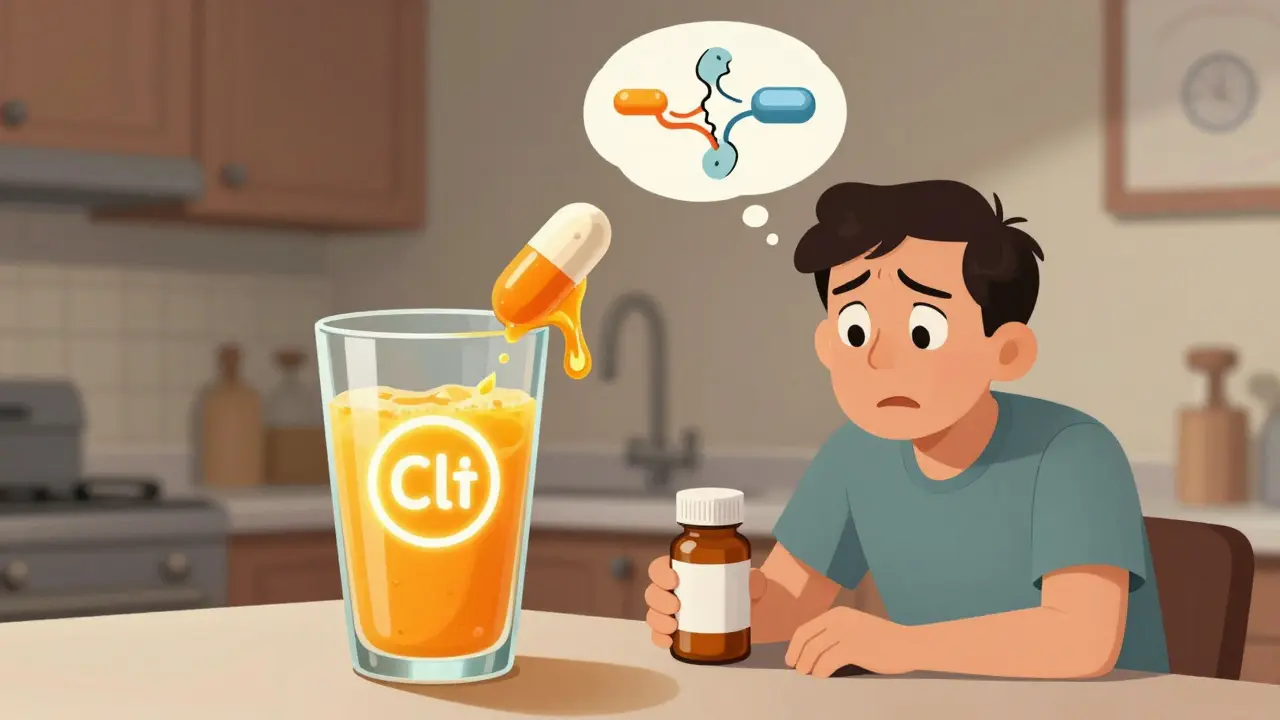
Many people drink calcium-fortified orange juice thinking it’s a healthy choice-especially if they avoid dairy. But what if that glass of juice is quietly ruining your medication? It’s not just a myth. Calcium-fortified juices can block your body from absorbing key drugs, leading to treatment failure, worsening symptoms, and even hospital visits. And most people have no idea.
How Calcium Binds to Medications
Calcium in fortified juices doesn’t just sit there. It actively grabs onto certain drugs in your gut, forming big, sticky complexes your body can’t absorb. Think of it like glue. When calcium ions (from calcium carbonate or calcium citrate) meet drugs like antibiotics or thyroid medicine, they latch on tightly. These complexes are too large to pass through the intestinal wall, so the drug just passes through you-useless.This isn’t theoretical. Lab studies show calcium concentrations as low as 300 mg per liter can reduce drug dissolution by up to 80%. That’s not a small drop-it’s a total shutdown. And the calcium in a single 8-ounce serving of fortified orange juice? Around 300-350 mg. That’s the same as a glass of milk.
Medications That Get Blocked
Not all drugs are affected. But the ones that are? They’re critical. Here’s who’s at risk:- Tetracycline antibiotics (doxycycline, minocycline): Used for acne, Lyme disease, and respiratory infections. Calcium binds to them so tightly, they become nearly inactive.
- Fluoroquinolones (ciprofloxacin, levofloxacin): Commonly prescribed for UTIs and sinus infections. One study found 25-30% of patients taking ciprofloxacin with calcium juice had treatment failure-compared to just 8-10% when taken correctly.
- Bisphosphonates (alendronate, risedronate): Used for osteoporosis. If you take these with calcium juice, you might as well be drinking water. The drug won’t reach your bones.
- Levothyroxine (Synthroid, Levoxyl): The standard treatment for hypothyroidism. Calcium can reduce absorption by 35-55%. Patients often need higher doses just to get their TSH levels back in range.
- Antifungals (ketoconazole): Used for fungal infections. Calcium interferes with how the drug dissolves, making it less effective.
These aren’t rare drugs. Millions take them daily. And if you’re drinking calcium-fortified juice with any of these, you’re not just reducing effectiveness-you’re risking real health consequences.
Why Orange Juice Is Worse Than Milk
You might think, “I’ve always had milk with my pills. Why is juice different?” Because orange juice adds a second problem: citric acid.Calcium alone is bad enough. But when you combine it with citric acid-like in fortified orange juice-the pH in your stomach drops. That changes how some drugs dissolve. A 2021 study found calcium-fortified orange juice cut ciprofloxacin absorption by 42%, while plain calcium-fortified water only dropped it by 31%. The acid makes the binding worse.
And here’s the kicker: most people think “dairy” is the only problem. They assume fortified juice is safe because it’s “fruit.” That’s a dangerous assumption. A 2022 survey found 68% of patients believed calcium-fortified juices were “safe” with medications. They’re wrong.

How Long Should You Wait?
It’s not enough to just take your pill and juice at different meals. Timing matters. And it’s different for every drug.- Tetracyclines: Wait 2-3 hours before or after taking calcium.
- Bisphosphonates: Take on an empty stomach with plain water. Wait at least 30 minutes before eating or drinking anything-especially calcium.
- Levothyroxine: The American Thyroid Association recommends a 4-hour gap. That means if you take your pill at 7 a.m., don’t drink that fortified OJ until 11 a.m. or later.
Many patients think “I’ll just take it at night.” But if you’re taking levothyroxine in the morning (as most doctors recommend), and you drink juice with breakfast, you’re already breaking the rule. And if you take it at night, you might be drinking juice with dinner-still too close.
Real Consequences: What Happens When It Goes Wrong
This isn’t just about lab numbers. People suffer real outcomes.A 2022 study of 1,894 patients on levothyroxine found those who drank calcium-fortified juice had 2.3 times higher odds of having TSH levels outside the safe range. That means fatigue, weight gain, depression, brain fog-symptoms they thought were “just aging,” but were actually untreated hypothyroidism.
Another study on ciprofloxacin showed that patients who drank calcium juice with their antibiotic had higher rates of recurring UTIs. One woman on a patient forum wrote: “My doctor never mentioned calcium OJ would interfere with my Synthroid-I was drinking two glasses daily with my morning pill for six months before my TSH levels finally got checked and were sky-high.”
Pharmacists are seeing this every day. A 2023 survey of 512 community pharmacists found 73% regularly encounter patients taking calcium-fortified juice with affected medications. But only 28% of those patients remembered being warned.

Why Labels Don’t Help
You’d think the juice bottle would warn you. But it doesn’t.A 2023 analysis of 47 popular calcium-fortified juice products found that 92% had no mention of drug interactions on the label. All they say is “High in Calcium” or “Supports Bone Health.” Nothing about antibiotics. Nothing about thyroid meds.
The FDA has called this out. In its 2023 draft guidance, it noted that current labeling focuses only on nutritional benefits-not risks. Meanwhile, medication labels often don’t mention juice either. The responsibility falls on the patient… who has no idea.
What You Can Do
You don’t have to give up fortified juice. But you need to be smart about it.- Check your medication’s label or package insert for food interactions.
- Ask your pharmacist: “Does this medicine interact with calcium-fortified juice?” Don’t assume they’ll bring it up.
- If you take levothyroxine, take it with plain water, on an empty stomach, and wait 4 hours before drinking fortified juice.
- If you take ciprofloxacin or doxycycline, avoid calcium juice for at least 2-3 hours before and after your dose.
- Switch to non-fortified juice or plain water if you’re on any of these medications long-term.
And if you’re a caregiver or parent? Don’t assume your child’s calcium-fortified juice is safe with their antibiotics. Always check.
The Bigger Picture
This isn’t just about one juice or one drug. It’s about how we treat food-drug interactions in modern healthcare. We assume patients know. We assume labels will warn us. We assume “natural” means “safe.”The reality? The U.S. healthcare system loses an estimated $417 million a year because of these interactions-extra doctor visits, repeat prescriptions, hospitalizations. And it’s entirely preventable.
Some companies are trying to fix it. Nestlé Health Science has a patent for a new calcium form that doesn’t bind as easily to drugs. Pharmacists are testing QR codes on pill bottles that link to food interaction guides. But until those become standard, the burden is on you.
You’re not being paranoid. You’re being smart. That glass of juice? It’s not helping your bones if it’s hurting your treatment.
Can I drink calcium-fortified juice if I’m on antibiotics?
No-not if you’re taking tetracyclines like doxycycline or fluoroquinolones like ciprofloxacin. Calcium in the juice binds to these drugs and stops your body from absorbing them. Wait at least 2-3 hours before or after taking the antibiotic. If you’re unsure, check the label or ask your pharmacist.
Does calcium-fortified orange juice affect thyroid medication?
Yes. Calcium can reduce absorption of levothyroxine (Synthroid) by 35-55%. This can cause your TSH levels to rise, leading to symptoms like fatigue, weight gain, and depression. The American Thyroid Association recommends waiting 4 hours after taking your thyroid pill before consuming calcium-fortified juice or any calcium supplement.
Is milk worse than calcium-fortified juice for drug interactions?
Both contain calcium and can interfere with medications. But calcium-fortified orange juice is often worse because it also contains citric acid, which lowers stomach pH and further reduces how well some drugs dissolve. Studies show orange juice causes more absorption reduction than plain calcium water.
What should I drink instead of calcium-fortified juice with my meds?
Plain water is the safest option. If you need flavor, try regular (non-fortified) juice, herbal tea, or sparkling water. Avoid any beverage with added calcium, iron, magnesium, or aluminum-these can also interfere with absorption. Always check the nutrition label for “calcium” in the ingredients.
Why don’t doctors tell me about this?
Many don’t realize how common this is. A 2022 survey found that 81% of calcium-fortified juice consumers didn’t know about the interaction. Doctors are often rushed, and food-drug interactions aren’t always part of standard prescribing checks. That’s why it’s up to you to ask your pharmacist-they’re trained specifically for this.





Comments (11)