

Anal fissures aren’t rare. They’re one of the most common reasons people end up in a doctor’s office with sharp, burning pain during or after a bowel movement. If you’ve ever felt like someone just stabbed you with a knife every time you went to the bathroom, you’re not alone. About 264,000 people in the U.S. deal with this each year. And while it sounds alarming, most cases aren’t dangerous - but they’re incredibly painful and can ruin your daily life if left untreated.
What Exactly Is an Anal Fissure?
An anal fissure is a small tear in the lining of the anal canal - the last few centimeters of your digestive tract. It’s not a cut you can see from the outside, but a split in the sensitive mucous membrane inside. The tear usually happens right at the back (posterior midline) of the anus. In fact, 90% of all fissures occur there. The rest show up in the front (anterior midline). This isn’t random - it’s because the blood supply in that area is weaker, making it more prone to injury.
Most fissures start from something simple: straining during a bowel movement. Hard stools, constipation, or even a big, forceful poop can stretch the tissue beyond its limit. In babies, it often happens with their first stools. In adults, it’s usually tied to diet, dehydration, or chronic diarrhea. But once the tear happens, the real problem begins - not the tear itself, but what happens next.
The Pain-Spasm Cycle: Why It Won’t Heal
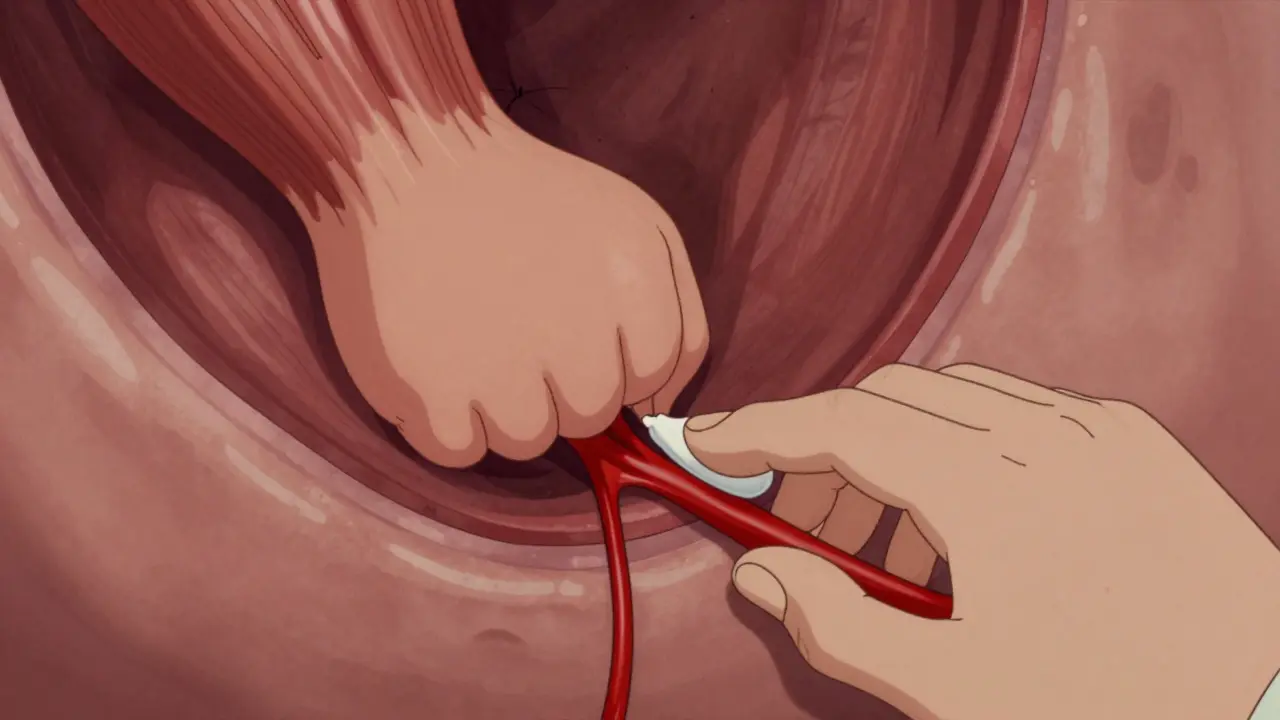
Here’s where things get tricky. The moment you feel that sharp pain during a bowel movement, your body reacts. The internal anal sphincter - a muscle you can’t control - goes into spasm. It tightens up hard, like a clenched fist. This raises the pressure inside the anus from a normal 15-20 mmHg up to 25-30 mmHg or higher. That extra pressure cuts off blood flow to the tear by 40-60%. No blood flow means no healing. And without healing, the pain stays. So you tense up again the next time you go, and the cycle keeps going.
This is why some fissures heal on their own in 6-8 weeks, while others drag on for months. If the muscle stays tight, the body can’t repair the tissue. That’s what turns an acute fissure into a chronic one. Chronic fissures come with their own signs: a small skin tag near the tear (called a sentinel pile), and a swollen anal papilla inside. These aren’t just symptoms - they’re proof the healing cycle has broken down.
How Common Is It? Who Gets It?
It happens to men and women equally until age 50. After that, women are three times more likely to develop fissures - mostly because of childbirth. But it’s not just older adults. Infants get them too. In fact, 64 out of every 1,000 newborns will have one. Adults between 20 and 40 are the next biggest group.
What’s surprising is how often it’s missed. Reddit’s r/Proctology has over 140 verified stories from people who went to their GP with pain and bleeding, only to be told it was hemorrhoids - or worse, ignored. The average time to get a correct diagnosis? 11.3 days. That’s over a week of suffering because the symptoms look familiar. And here’s the catch: up to 10% of people diagnosed with a fissure actually have something else - Crohn’s disease, an infection, or even cancer. That’s why if it doesn’t heal in 8 weeks, you need a specialist.
Healing Without Surgery: The First Line of Defense
Before you think about drugs or surgery, the simplest fix is often the best: change how you eat and go to the bathroom.
- Up your fiber. Aim for 25-35 grams a day. That’s 3 cups of cooked broccoli, a big bowl of oatmeal, a pear, and a handful of almonds. Too little fiber? You’re more likely to strain. Too much? Some people get bloated or worse - 12% of patients say excessive fiber makes symptoms worse.
- Drink water. Eight to ten glasses a day. No, soda and coffee don’t count. Water softens stool and helps fiber do its job.
- Sitz baths. Sit in warm water for 10-20 minutes, 3-4 times a day. Do it right after you poop. It relaxes the muscle, reduces pain, and improves blood flow. Many people report feeling better within a few days.
These three steps alone heal 82% of acute fissures, according to Healthdirect Australia. But if you’re still stuck after a couple of weeks, it’s time to add something stronger.
Topical Treatments: What Actually Works
There are three main ointments doctors recommend - and not all of them are created equal.
| Treatment | Healing Rate | Side Effects | How to Apply |
|---|---|---|---|
| Nitroglycerin (0.2-0.4%) | 45-68% | Headaches (20-32%), dizziness | 1.25 inches on finger, insert 1 inch into anus, twice daily |
| Diltiazem (2%) | 65-75% | Mild irritation, rare | Same as above. Often preferred over nitroglycerin. |
| Nifedipine (0.3%) | 65-75% | Minimal side effects | Same application. Recommended as first-line by Mayo Clinic. |
Nitroglycerin has been around longer, but headaches are so common that many people quit using it. Diltiazem and nifedipine work just as well - or better - with far fewer side effects. In fact, the European Society of Coloproctology now recommends diltiazem as the first choice for medication.
Apply it correctly. Use a clean finger. Put on a glove if you want. Insert the ointment about an inch inside the anus. Do it twice a day. Don’t just smear it on the outside - the tear is inside. Most people feel pain relief within 72 hours. Complete healing? Around 6 weeks.
Botox and Surgery: When Things Get Serious
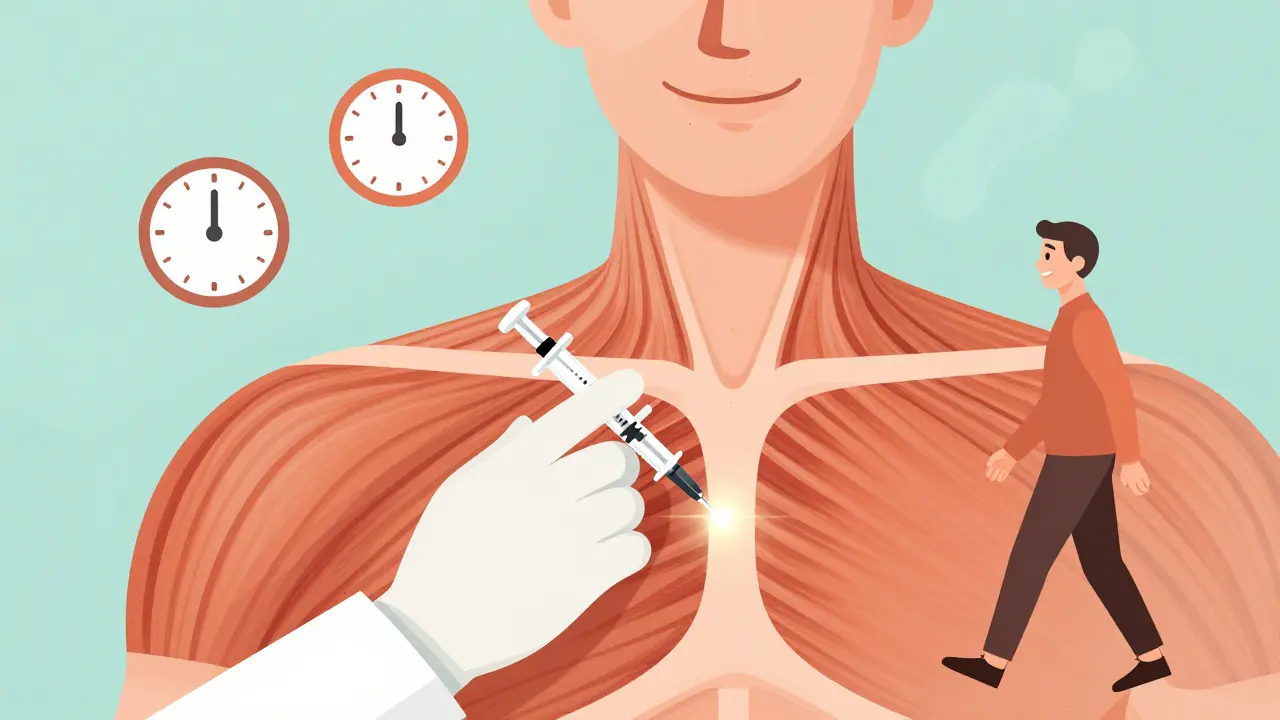
If ointments don’t work, the next step is a botulinum toxin (Botox) injection. It’s not what you think. It’s not a wrinkle treatment - it’s a muscle relaxer. A doctor injects 15-30 units directly into the internal sphincter. This temporarily paralyzes the muscle, breaking the spasm cycle. Healing rates? Between 50% and 80%.
But here’s the catch: 40% of people who get Botox see the fissure come back within a year. And sometimes, you need a second injection. That’s why many doctors use it as a bridge - not a cure.
If everything else fails, surgery is the gold standard. A lateral internal sphincterotomy means cutting a tiny bit of the internal sphincter muscle. It sounds scary, but it’s quick - 15-20 minutes under local anesthesia. Success rate? 92-98%. Most people are back at work in 3.5 days.
But there’s a trade-off. About 14% of patients develop minor fecal incontinence - usually just a little trouble holding gas or a few drops of stool. It’s not life-changing for most, but it’s something to consider. That’s why surgery is only done after everything else has been tried.
What Doesn’t Work (And Why)
Not all advice you hear is backed by science.
- Stool softeners alone - they help, but they don’t fix the muscle spasm. You still need fiber and water.
- Over-the-counter hemorrhoid creams - they numb the surface, but they don’t reach the tear inside. They might give temporary relief, but they won’t heal the fissure.
- Waiting it out without changes - if you don’t adjust your diet or habits, the tear will likely stay. Chronic fissures don’t heal on their own.
And don’t forget: 38% of failed treatments are because people didn’t stick with the fiber plan. And 29% of topical treatment failures? That’s because people didn’t apply the ointment deep enough.
What’s New in 2026?
Research is moving fast. In 2023, Johns Hopkins tested stem cell injections in 32 patients with stubborn fissures. 73% healed in 8 weeks. It’s still experimental, but it’s promising. And with rising obesity and low-fiber diets, experts warn that fissure rates could go up by 15-20% in the next decade.
The takeaway? You don’t have to live with this pain. Most fissures heal with simple changes. But if they don’t, there are clear, proven steps to take - from diet to ointments to surgery. The key is acting early and sticking with the plan.
Can anal fissures turn into cancer?
No, anal fissures themselves don’t turn into cancer. But up to 10% of people diagnosed with a fissure actually have another condition - like Crohn’s disease, an infection, or even rectal cancer. That’s why if a fissure doesn’t heal within 8 weeks, or if you have other symptoms like unexplained weight loss, bleeding from other areas, or a family history of colon cancer, you need a colonoscopy or biopsy to rule out something more serious.
Is it normal to bleed with an anal fissure?
Yes, light bleeding is common. You’ll usually see bright red blood on the toilet paper or in the bowl - not mixed with stool. It’s not heavy like a period, but more like a few drops. If the bleeding is constant, dark, or mixed with mucus, it could signal something else. Always get persistent bleeding checked out.
Can I have sex with an anal fissure?
Anal sex is not recommended while you have an active fissure. It can reopen the tear and worsen pain and bleeding. Even gentle penetration can cause damage. Wait until the fissure is fully healed - which usually takes 6-8 weeks with treatment. If you’re unsure, talk to your doctor before resuming any anal activity.
How long does it take to heal with diltiazem?
Most people notice pain relief within 72 hours. Complete healing usually happens in about 6 weeks. You need to use it consistently - twice a day for at least 8 weeks - even if the pain goes away sooner. Stopping early increases the risk of the fissure coming back.
Can children get anal fissures?
Yes, and it’s common in infants. Around 64 out of every 1,000 newborns develop a fissure, often after their first hard stools. In older children, it’s usually from constipation. Treatment is simple: increase fluids, add fiber (like prune juice or applesauce), and use warm baths. Topical ointments are rarely needed in kids unless it’s chronic.
What to Do Next
If you’re in pain right now, start here: eat 30 grams of fiber today. Drink three extra glasses of water. Take a sitz bath tonight. That’s your first step. If the pain doesn’t drop by half in 3 days, try a topical ointment. If it’s still there after 6 weeks, see a colorectal specialist. You don’t need to suffer. Healing is possible - and it’s often simpler than you think.




Comments (9)