
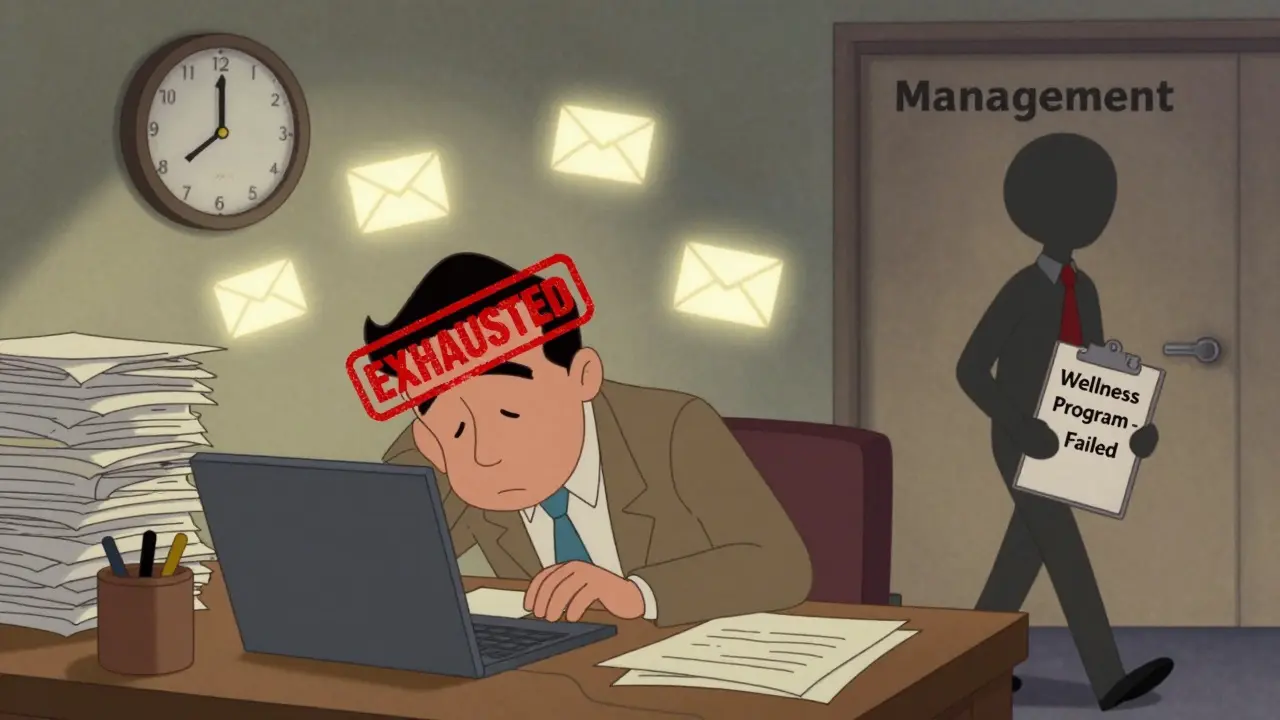
By the end of 2025, nearly one in four workers globally will say they’re burned out - not just tired, but emotionally drained, disconnected from their job, and doubting their own competence. This isn’t just a personal problem. It’s a systemic one. And if you’re reading this, you or someone you work with is probably already there.
What Burnout Really Feels Like
Burnout isn’t just working too hard. It’s what happens when you’ve been pushing through stress for months - or years - without real recovery. The World Health Organization defines it as a syndrome with three clear signs: exhaustion, cynicism, and reduced performance. You’re not lazy. You’re not weak. You’re just running on empty.
Think about it: Do you wake up dreading Monday? Do you scroll through emails after dinner even though you promised yourself you wouldn’t? Do you catch yourself thinking, “What’s the point?” when someone asks how your project is going? If so, you’re not alone. Gallup’s 2023 report found that 23% of employees feel burned out very often or always. Another 44% feel considerable stress every single day.
The physical signs are just as real. Insomnia. Brain fog. Constant fatigue. A 2022 APA survey showed 34% of stressed workers felt exhausted all the time. 29% lost motivation. 26% felt anxious. These aren’t vague feelings - they’re measurable symptoms tied to chronic stress.
Why Burnout Happens (It’s Not Your Fault)
Most people think burnout comes from working long hours. But the real culprits are deeper - and they’re built into how work is organized.
The Job Demands-Resources model, developed by researchers Arnold Bakker and Evangelia Demerouti, breaks it down into six key drivers:
- Excessive workload - 67% of employees say this is their biggest stressor.
- Lack of control - 49% feel they have no say in how they do their job.
- Insufficient rewards - 42% feel their effort isn’t recognized or compensated fairly.
- Breakdown of community - 38% feel isolated or unsupported at work.
- Absence of fairness - 34% see favoritism, inconsistent rules, or poor leadership.
- Conflicting values - 29% feel their work goes against their personal ethics.
Dr. Christina Maslach, who created the gold-standard burnout measurement tool (the Maslach Burnout Inventory), says it clearly: “Burnout is not an individual failure. It’s a systems failure.” If your job is designed to drain you, no amount of meditation or yoga will fix it.
Prevention Starts With the Organization
Companies are spending $12.5 billion on wellness programs by 2025. But here’s the catch: 68% of these programs fail - not because employees don’t care, but because managers aren’t held accountable.
Successful prevention isn’t about free snacks or yoga mats. It’s about changing how work gets done.
Workload audits every quarter - not once a year - reduce burnout by 78% when tied to actual role adjustments. Companies like Salesforce and Microsoft use AI tools to track task loads and redistribute work before people break.
Flexible schedules - especially “Work-from-Home Wednesdays” and core hours instead of fixed 9-to-5 - cut burnout by 27%. Why? Because people work better when they’re in control of their energy, not their clock.
“Digital sunset” policies - where systems automatically log you out after work hours - reduce after-hours messages by 31% and burnout by 26%. This isn’t a perk. It’s a safety measure.
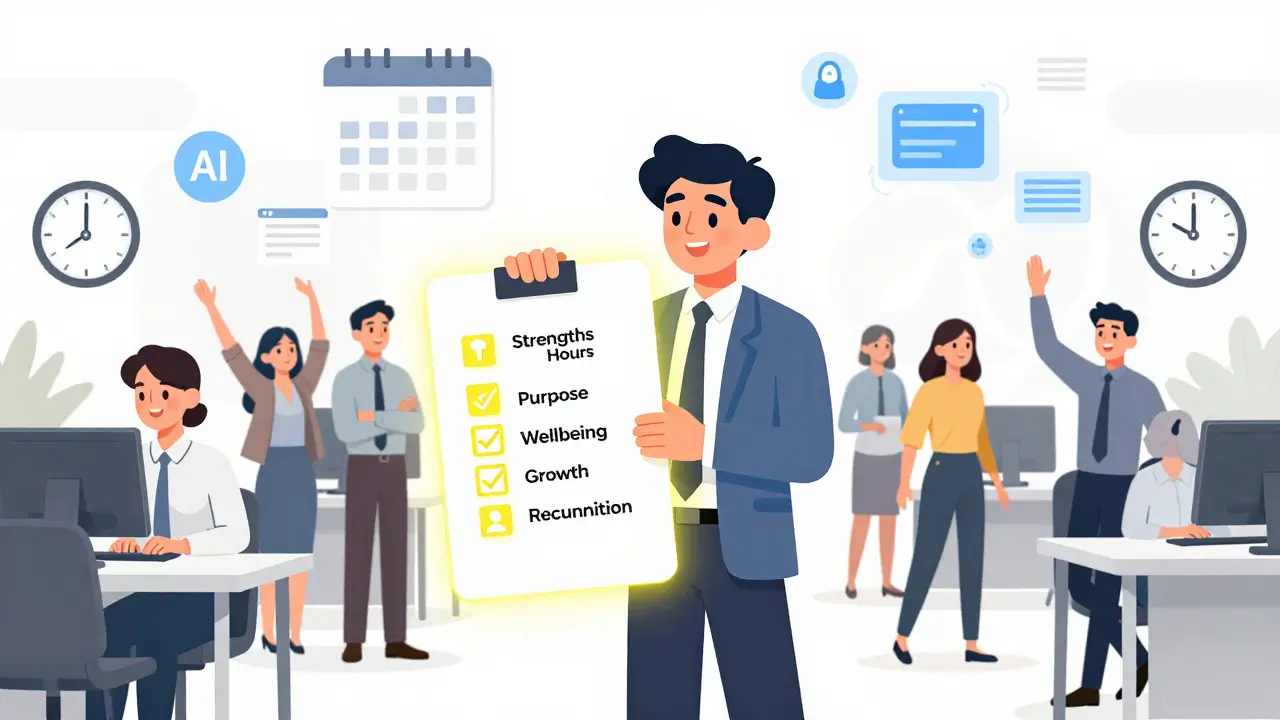
And managers? They’re the linchpin. Gallup found that managers who have five key conversations - about strengths, purpose, wellbeing, growth, and recognition - see 41% lower burnout in their teams. That’s not luck. That’s leadership.
What You Can Do Right Now
Even if your company hasn’t fixed the system yet, you can protect yourself.
Set hard boundaries - no emails after 6 PM. No Slack after dinner. A 2024 APA study found employees who do this have 39% lower burnout rates. It’s not rude. It’s sustainable.
Time-block your day - not just tasks, but breaks. Work for 90 minutes. Then take 5 to 10 minutes away from the screen. Harvard Business Review found this boosts productivity by 13% and cuts burnout markers by 17%.
Walk before and after work - a 15-minute walk in the morning and another at night, as recommended by MIT’s 2024 study, lowers stress by 22%. It’s not exercise. It’s transition. It tells your brain: work is done.
Track what you’ve done, not what’s left - instead of a to-do list, keep an “accomplished list.” Keystone Partners found this simple shift speeds up recovery by over three weeks. You’re not failing. You’re just not seeing your wins.
Move your body - walking meetings are used by 68% of Fortune 500 companies. They reduce sedentary time by 27 minutes a day. That’s not just about health. It’s about clearing your head.
Recovery Isn’t Optional - It’s a Process
Recovering from burnout isn’t about taking a week off. It’s about rebuilding your relationship with work - slowly and intentionally.
Gallup’s three-phase recovery plan works:
- Recognition - use tools like the Q12 survey to spot early signs before you crash.
- Intervention - get your workload adjusted. Temporarily shift tasks. Say no. Protect your time.
- Restoration - return with protected hours, no back-to-back meetings, and space to breathe.
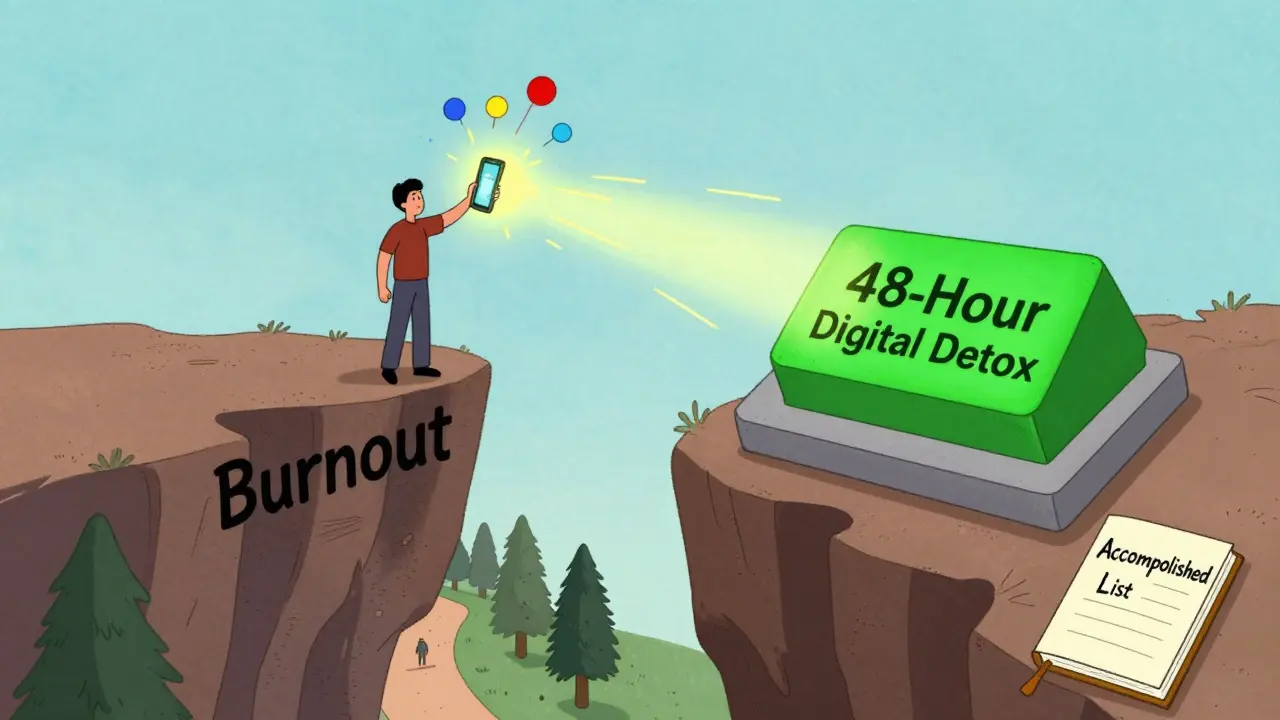
And here’s the most powerful tool: strategic disengagement. A 48- to 72-hour digital detox - no work emails, no Slack, no notifications - improves emotional exhaustion by 63%, according to the APA. It’s not a vacation. It’s a reset.
Use your mental health benefits. Spring Health found employees who seek help within 14 days of noticing symptoms recover 82% faster than those who wait. That’s not weakness. That’s strategy.
Why Most Programs Fail - And How to Fix It
Organizations launch wellness initiatives. They look good on paper. Then, after a year, they disappear. Why? Because they’re treated like a perk, not a priority.
The companies that succeed do three things:
- They tie wellbeing to performance reviews - 30% of managers now have it as a formal metric (up from 12% in 2021).
- They embed prevention into onboarding - one healthcare provider added 4.5 hours of burnout training for new hires. Adherence jumped 52%.
- They follow a 30-60-90 day plan: psychological safety in 30 days, workload audits in 60, cultural change in 90.
And they stop blaming the individual. They fix the system.
The Future Is Predictive
By late 2025, 65% of Fortune 500 companies will use AI to predict burnout before it happens - analyzing email patterns, calendar density, and meeting load to flag at-risk employees with 82% accuracy.
Some companies are going further. Basecamp and Shopify have adopted 4-day workweeks. Neurobloom Colorado is using heart rate variability (HRV) monitors to track stress in real time - and saw 29% better results than traditional methods.
The biggest shift? Moving from reactive to predictive. Instead of waiting for someone to quit or crash, companies are now using data from sick days, EAP usage, and productivity dips to predict burnout risk - and intervene early. Early adopters like American Express and Procter & Gamble have cut burnout incidence by 38%.
What You Need to Remember
Burnout isn’t something you endure. It’s something you recover from - and prevent. You can’t outwork it. You can’t meditate it away. You can’t power through.
Real change comes when organizations stop treating mental health as a bonus and start treating it as a core part of how work gets done. And you? You don’t have to wait for them to catch up.
Start small. Protect your time. Say no. Walk before and after work. Track your wins. Use your benefits. And if your company won’t change? That’s not your failure. It’s their blind spot.
You’re not broken. You’re just working in a system that’s broken. And you’re not alone in fixing it.
What are the main signs of workplace burnout?
The three core signs are: 1) chronic exhaustion or energy depletion, 2) increased mental distance from your job - like feeling cynical or detached - and 3) reduced professional efficacy, where you feel less competent or productive than before. Physical symptoms include insomnia, brain fog, fatigue, and irritability. Gallup’s 2023 data shows 63% of burned-out workers report chronic fatigue, and 42% struggle with sleep.
Can burnout be fixed without changing jobs?
Yes - but only if the root causes are addressed. If your burnout comes from an unsustainable workload, lack of control, or poor management, changing jobs won’t help unless the new job fixes those issues. Recovery requires systemic changes: workload adjustments, boundary enforcement, psychological safety, and time for rest. Many people recover fully while staying in the same role - especially when managers support them.
How long does burnout recovery take?
There’s no fixed timeline, but research shows recovery speeds up dramatically with the right support. Employees who use mental health benefits within 14 days of noticing symptoms recover 82% faster than those who delay. Strategic disengagement - like a 48- to 72-hour digital detox - can improve emotional exhaustion markers by 63% in just a few days. Full restoration typically takes 3 to 6 months, depending on severity and support.
Is burnout the same as depression?
No - but they can overlap. Burnout is specific to the workplace and stems from chronic job stress. Depression is a clinical condition that affects mood, sleep, appetite, and self-worth across all areas of life. Many people with burnout develop depressive symptoms, but not everyone with depression is burned out. The key difference: burnout improves with workplace changes; depression often needs clinical treatment.
Why do so many burnout prevention programs fail?
Most fail because they treat burnout as an individual problem - offering yoga or mindfulness apps while leaving toxic workloads, unfair policies, and poor management unchanged. The real issue? Managers aren’t held accountable. Successful programs tie wellbeing to performance reviews, embed prevention into onboarding, and use data to track progress. Without systemic change, wellness programs are just noise.
What’s the most effective individual strategy to prevent burnout?
The most effective individual strategy is setting and enforcing clear boundaries - especially around work hours and communication. Employees who avoid checking emails after 6 PM experience 39% lower burnout rates. Pair that with time-blocking your work and breaks, and daily walks to separate work from personal time. These aren’t luxuries. They’re non-negotiable for sustainability.
Can a 4-day workweek really reduce burnout?
Yes - and the data supports it. Companies like Basecamp and Shopify have adopted 4-day weeks with no loss in productivity. Pollack Peacebuilding’s 2023 forecast shows adoption will rise from 12% to 37% of tech companies by 2025. The key isn’t just fewer days - it’s fewer hours, fewer meetings, and protected time. When people have more recovery space, they’re more focused, less stressed, and less likely to burn out.





Comments (11)