
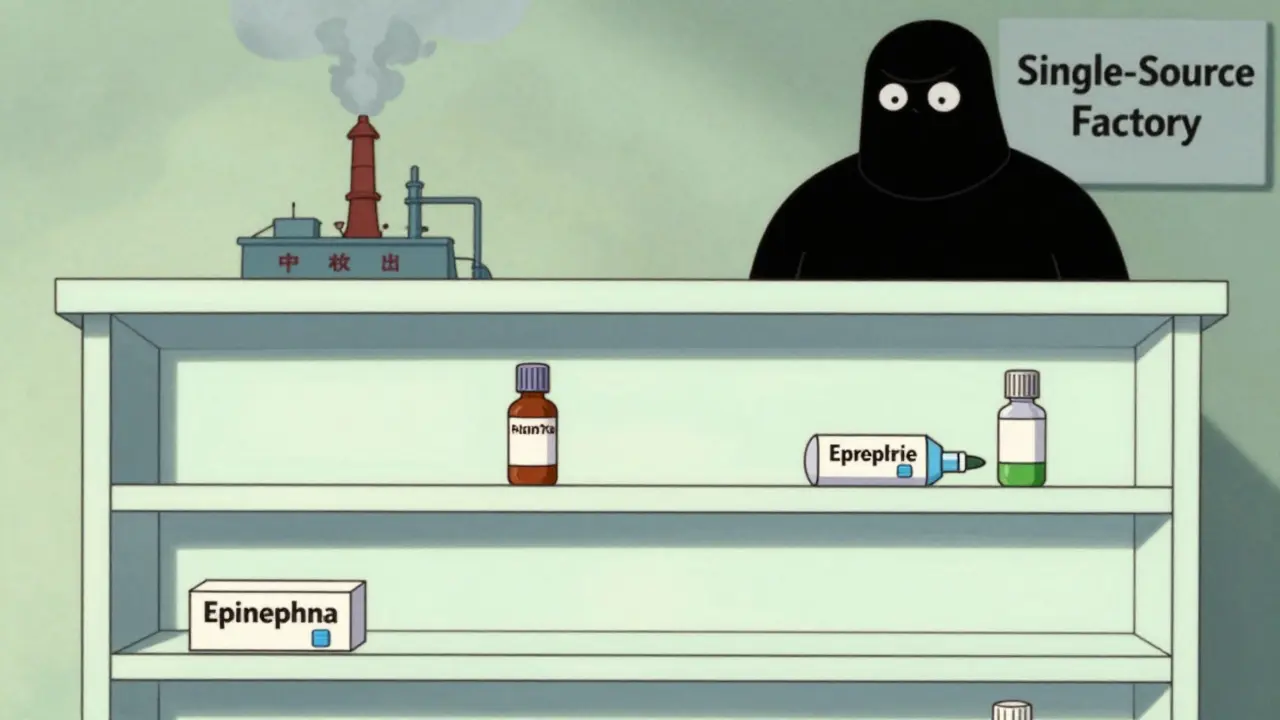
Drug shortages aren’t just inconvenient-they’re dangerous. When a life-saving antibiotic or heart medication disappears from shelves, people delay treatment. Some die. And it’s not rare. In 2024, the U.S. faced over 300 drug shortages, with 40% linked to problems in making the active ingredients. The truth? Most of these shortages were predictable. And they’re preventable.
Why Your Medicine Might Vanish Tomorrow
It starts with where drugs are made. About 80% of the active ingredients in U.S. medicines come from overseas-mostly China and India. One factory fire, a trade dispute, or a sudden export ban can ripple across the entire system. A single plant in China that makes a generic blood thinner can leave hospitals scrambling. And because companies run lean supply chains-keeping just enough inventory to meet daily demand-there’s no safety net.
When a crisis hits, like during COVID-19, the system cracks. Hospitals ran out of sedatives. Cancer patients waited weeks for chemo. Even simple antibiotics became scarce. The problem isn’t just global. It’s structural. Companies focused on cutting costs, not building backup plans. Now, the price is paid in lives.
What Resilience Really Means
Resilience isn’t about making everything in America. It’s about making sure critical medicines don’t disappear when the world gets messy. The U.S. Department of Health and Human Services defines it clearly: the ability to anticipate, respond to, and recover from disruptions while keeping essential drugs flowing.
Think of it like a flood system. You don’t build a dam to stop every storm. You build levees, drainage, and emergency pumps. Same here. You need multiple ways to get the same medicine-even if it costs a little more.
Three Practical Steps to Stop Shortages Before They Start
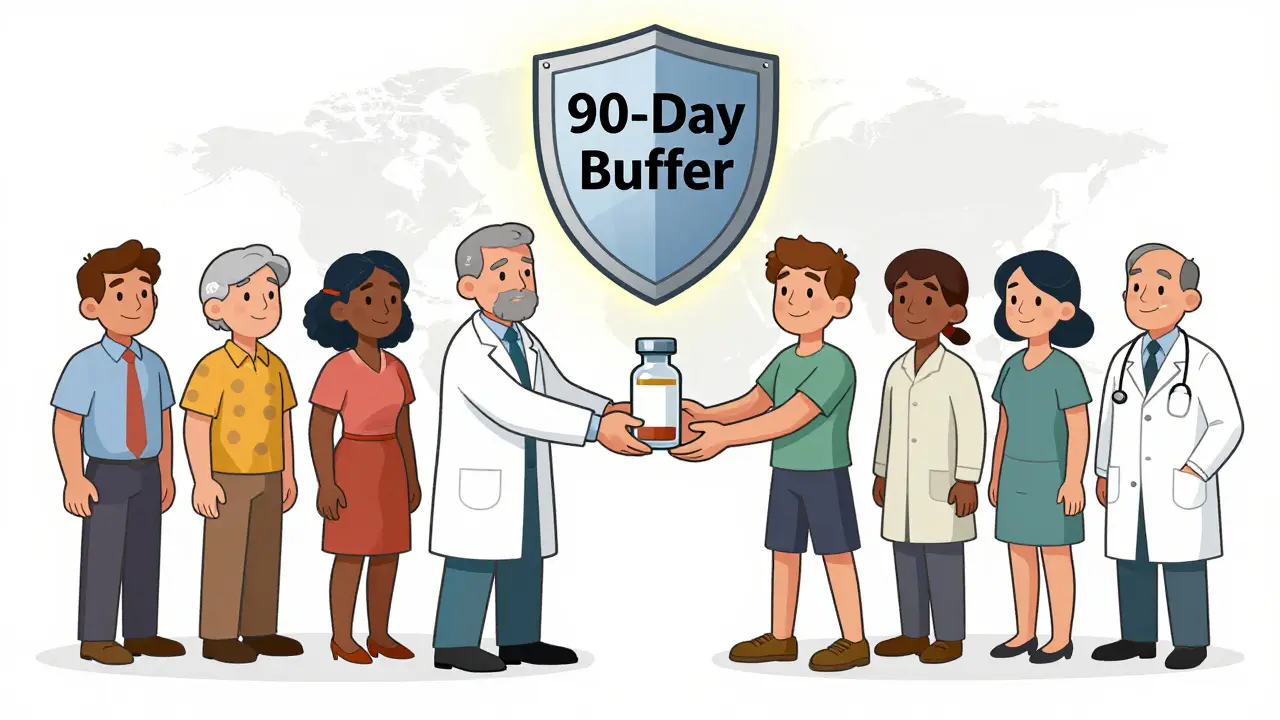
- Keep 60 to 90 days of buffer stock for critical drugs-not just a few weeks. This includes antibiotics, insulin, epinephrine, and heart medications. Companies that do this cut their risk of running out by 70%. It’s not expensive compared to the cost of a hospital emergency caused by a shortage.
- Dual-source every key ingredient. Don’t rely on one supplier, even if they’re the cheapest. Find a second manufacturer, ideally in a different country. For example, if you get your API from India, find a backup in Germany or South Korea. Leading companies now dual-source 70-80% of their critical materials. That one move cuts disruption risk in half.
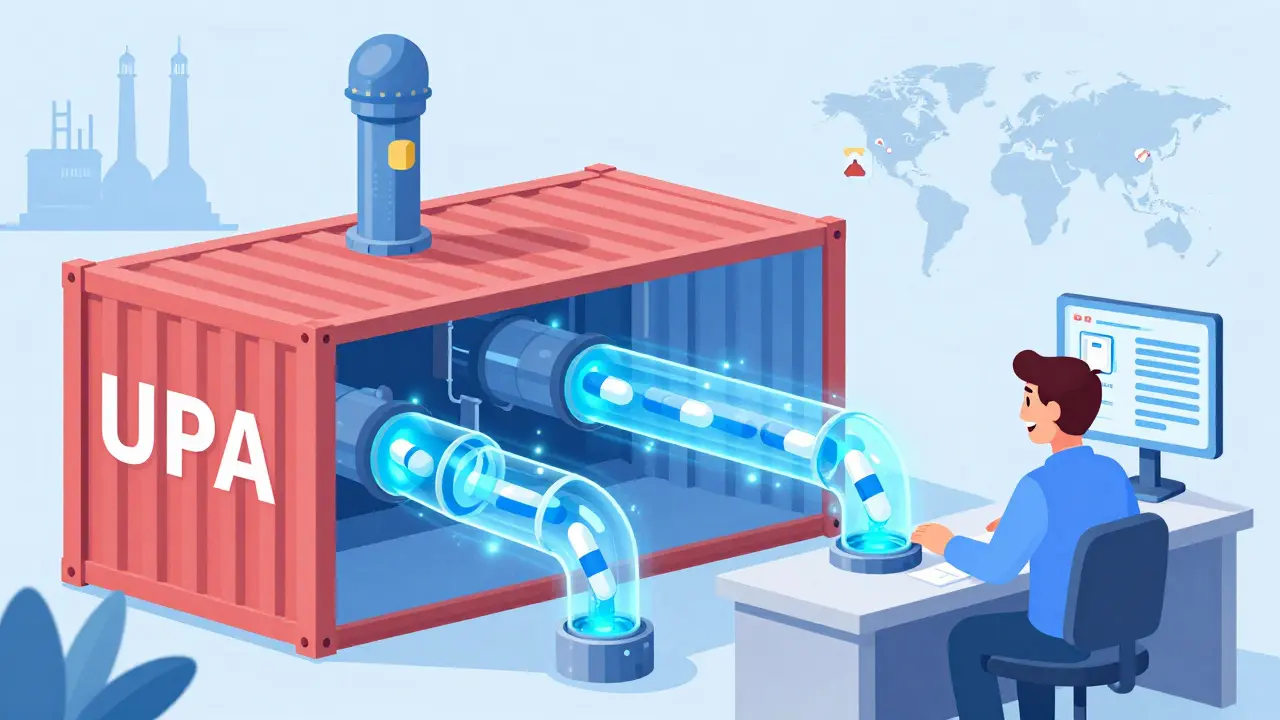
- Build regional manufacturing hubs. Instead of shipping everything across the ocean, set up smaller production sites in North America, Europe, and Southeast Asia. Container-based factories can be built in 12-18 months-not five years. They’re flexible, scalable, and can make 50kg to 2,000kg of active ingredient. These aren’t giant plants. They’re smart, modular units that can fill gaps fast.
Technology Is the Hidden Game-Changer
Old-school batch manufacturing-where drugs are made in big vats over weeks-is slow and wasteful. New continuous manufacturing systems churn out medicine like a流水线 (assembly line). They use 25% less energy, create 15-20% less waste, and cut production time by 40%. But only 12 FDA-approved facilities use this tech as of mid-2025. Why? Cost. A single continuous manufacturing line costs $50-150 million. Most companies can’t afford it.
But here’s the twist: AI is making it smarter. Predictive tools now forecast disruptions 60-90 days ahead with 85-90% accuracy. They watch weather patterns, political news, shipping delays, and even social media chatter about raw material shortages. One company in Boston used AI to spot a potential API shortage six months before it happened. They switched suppliers. No shortage. No panic.
Blockchain isn’t just for crypto. It’s being used to track every pill from raw ingredient to pharmacy shelf. In pilot programs, it cut counterfeit drugs by 75%. That’s huge. Fake medicines aren’t just scams-they’re deadly.
Government Action Is Real-But Not Enough
In August 2025, the U.S. government launched the Strategic Active Pharmaceutical Ingredients Reserve. The goal? Stockpile 90 days’ worth of 150 essential medicines by 2027. They’ve allocated $1.2 billion from the CHIPS Act and another $800 million in the 2025 budget to build domestic capacity.
It’s a start. But the reserve only covers 150 drugs. There are over 4,000 essential medicines in use. And domestic production still only makes up 28% of APIs. For sterile injectables? Just 12%. Antibiotics? 17%. You can’t build resilience on a few pills in a warehouse.
What’s missing? A unified strategy. Right now, the FDA approves new manufacturing tech slowly. It took 20 years to approve 12 continuous manufacturing lines. That’s like waiting for a horse-drawn cart to catch up to a Tesla.
The Real Cost of Doing Nothing
Companies that ignored resilience lost $14.7 million on average during major disruptions in 2024. That’s not just lost sales. It’s lawsuits, reputational damage, and lost trust from doctors and patients. Meanwhile, companies that invested in buffer stock, dual sourcing, and new tech saw a 1.8x return on investment within three years.
And it’s not just about money. The Department of Defense calls pharmaceutical supply chain gaps a “critical national security risk.” Imagine a conflict where a country cuts off your heart medication. That’s not sci-fi. It’s a real scenario being modeled in defense simulations.
Who’s Leading? Who’s Falling Behind?
Big pharma-with revenues over $10 billion-have 85% adoption of resilience programs. Mid-sized firms? Only 42%. Small companies? Just 18%. Why? They think it’s too expensive. But here’s the truth: resilience isn’t a luxury. It’s insurance. And insurance only matters when you need it.
Companies like Pfizer and Merck now spend 8-10% of their supply chain budget on resilience. Others still spend 2%. That gap will widen. And when the next crisis hits, the ones who didn’t prepare won’t just lose money-they’ll lose patients.
What You Can Do-Even If You’re Not a CEO
You don’t need to run a company to help. If you’re a pharmacist, ask your distributor: “Do you have dual sources for metformin? For insulin?” If you’re a doctor, ask your hospital: “Do we have a 90-day buffer for critical drugs?” If you’re a patient, ask: “Is there a generic alternative if my usual drug runs out?”
Pressure works. When 100 doctors in a city demand transparency, manufacturers listen. When pharmacies start tracking their inventory depth publicly, companies are forced to act.
The Future Isn’t Just Local or Global-It’s Balanced
Some say we should make everything in America. That’s unrealistic. It would raise drug prices by 20-30% and still leave us vulnerable if one domestic plant fails.
Others say we should rely on global supply chains. That’s dangerous. One earthquake in Taiwan, one political crackdown in India, and we’re back at square one.
The answer? A hybrid. Strategic domestic capacity for the most critical drugs. Regional hubs for common ones. And a global network for the rest-backed by real data, real backups, and real planning.
By 2030, 65-70% of U.S. medicines will come from regional networks. Domestic production will rise to 35-40%. That’s not a dream. It’s the forecast from McKinsey. And it’s achievable-if we act now.
Final Thought: Resilience Is a Choice, Not a Luck
Drug shortages aren’t accidents. They’re failures of planning. We knew this was coming. We had warnings after 2020. We had data. We had solutions. What we didn’t have was urgency.
Building a resilient supply chain isn’t about patriotism or politics. It’s about making sure the next person who needs a lifesaving drug doesn’t have to wait. Or worse-can’t get it at all.
It’s time to stop hoping for the best. Start planning for the worst.
What’s the biggest cause of drug shortages today?
The biggest cause is over-reliance on single-source manufacturers, especially in China and India, for active pharmaceutical ingredients (APIs). When one factory shuts down due to regulation, weather, or political issues, the entire supply chain breaks. About 80% of APIs come from overseas, and many companies keep only 2-4 weeks of inventory-leaving no room for error.
Does making drugs in the U.S. solve the problem?
Not alone. Domestic production currently covers only 28% of APIs. Building more U.S. factories helps, but it’s expensive and slow. The real solution is a mix: strategic domestic capacity for critical drugs, regional manufacturing in places like Canada or Eastern Europe, and diversified global sourcing-all backed by buffer stock and real-time tracking.
How much buffer stock is enough for critical medicines?
For essential medicines like insulin, epinephrine, or antibiotics, 60-90 days of inventory is the industry standard for resilience. This gives time to switch suppliers or ramp up production during a disruption. Some hospitals now keep 120 days for high-risk drugs, but 90 days is the minimum recommended by the FDA and WHO.
What’s continuous manufacturing, and why does it matter?
Continuous manufacturing is a modern production method where drugs are made in a steady flow, like a pipeline, instead of in batches. It’s faster, uses less energy, cuts waste by 15-20%, and reduces production time by 30-40%. It’s also more flexible-easier to scale up or down. Only 12 FDA-approved facilities use it as of 2025, but adoption is expected to hit 50% by 2027.
Can AI really predict drug shortages?
Yes. AI tools now analyze global data-shipping delays, political events, weather, factory maintenance schedules, and even raw material prices-to predict disruptions 60-90 days in advance with 85-90% accuracy. One major pharma company used AI to detect a potential API shortage six months early and switched suppliers before the crisis hit. No shortage. No panic.
What’s the government doing to fix this?
The U.S. government launched the Strategic Active Pharmaceutical Ingredients Reserve in 2025, aiming to stockpile 90 days of 150 essential medicines by 2027. They’ve allocated $2 billion in funding through the CHIPS Act and new budget proposals. The FDA is also speeding up approvals for new manufacturing tech, cutting review times from 3 years to under 18 months for qualified facilities.
How can I, as a patient, help prevent shortages?
Ask your pharmacist or doctor: “Do you have a backup for this medication?” If your drug is on shortage, ask if a generic version is available. Support policies that fund domestic API production and supply chain transparency. Your voice adds pressure-when enough patients ask, companies and regulators respond.




Comments (9)