
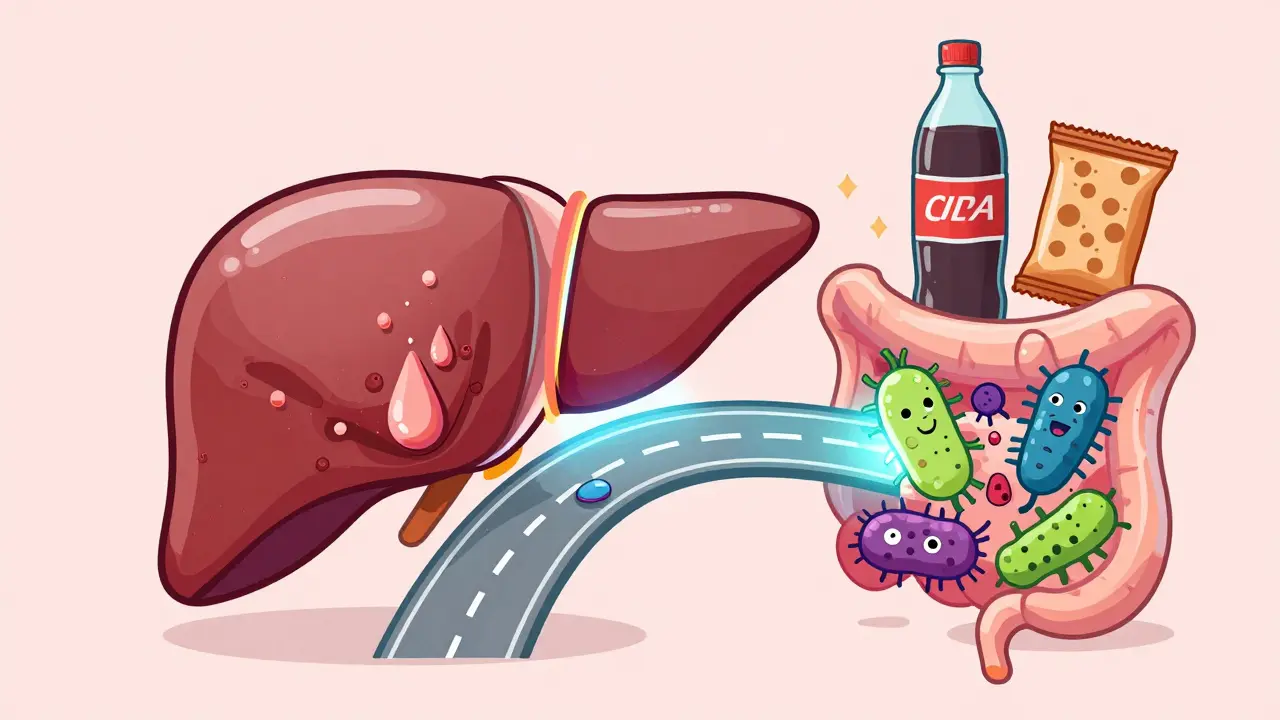
More than one in three adults worldwide has fat building up in their liver-not from drinking alcohol, but from how they eat. This isn’t just a minor issue. It’s called nonalcoholic fatty liver disease, or NAFLD, and it’s now the most common liver condition in the U.S., Europe, and Australia. The good news? You can turn it around-with food, weight loss, and a little help from your gut.
What’s Really Going On in Your Liver?
Your liver is your body’s main detox and metabolism hub. When it gets overloaded with sugar, especially fructose from soda, fruit juice, and processed snacks, it starts turning that excess into fat. Over time, that fat builds up inside liver cells. If it stays there long enough, inflammation kicks in, and that’s when simple fatty liver can turn into NASH-nonalcoholic steatohepatitis. That’s the dangerous version. It can lead to scarring, cirrhosis, or even liver cancer. But here’s the twist: your liver doesn’t work alone. It’s connected directly to your gut through a highway called the portal vein. Every time your gut lets something it shouldn’t-like bacterial toxins-into your bloodstream, your liver has to clean it up. And if your gut lining is leaky, your liver gets overwhelmed.Your Gut Microbiome Is a Silent Player
The trillions of bacteria living in your intestines aren’t just passengers-they’re active players in liver health. People with NAFLD have a different gut microbiome than healthy people. Studies show they have less diversity, fewer good bacteria, and more harmful ones. One common pattern? Lower levels of bacteria that make butyrate, a short-chain fatty acid that keeps your gut lining strong and tells your liver to stop storing fat. In people with NAFLD, fecal butyrate levels are about 58% lower than in healthy individuals. That’s not a coincidence. Without enough butyrate, your gut barrier weakens. Bacterial toxins like LPS (lipopolysaccharide) leak into your blood. Your liver detects them as invaders and fires up inflammation. In fact, LPS levels in NAFLD patients are more than twice as high as in people with healthy livers. And it gets worse. These gut bugs also mess with bile acids-chemicals your liver makes to digest fat. When the wrong bacteria break down bile acids, they trigger signals that make your liver store even more fat. It’s a vicious cycle: bad gut → leaky gut → liver inflammation → more fat storage.Diet Is the Most Powerful Tool You Have
The best treatment for NAFLD isn’t a pill. It’s a plate. And the most proven diet for reversing it? The Mediterranean diet. A 6-month study with 70 NAFLD patients showed that eating a Mediterranean diet-rich in olive oil, vegetables, nuts, whole grains, and fish-plus 30 grams of walnuts daily, reduced liver fat by 32%. That’s not just a number. That’s real, measurable improvement. Walnuts aren’t just healthy fats-they’re packed with fiber and polyphenols that feed your good gut bacteria. What does this diet actually look like?- Swap white bread and pasta for whole grains like oats, barley, and quinoa
- Use olive oil instead of butter or vegetable oil
- Eat at least 5 servings of vegetables daily-especially leafy greens, broccoli, and artichokes
- Snack on nuts (walnuts, almonds) and seeds (flax, chia)
- Choose fish like salmon or sardines over red meat
- Avoid sugary drinks, fruit juice, and anything with high-fructose corn syrup
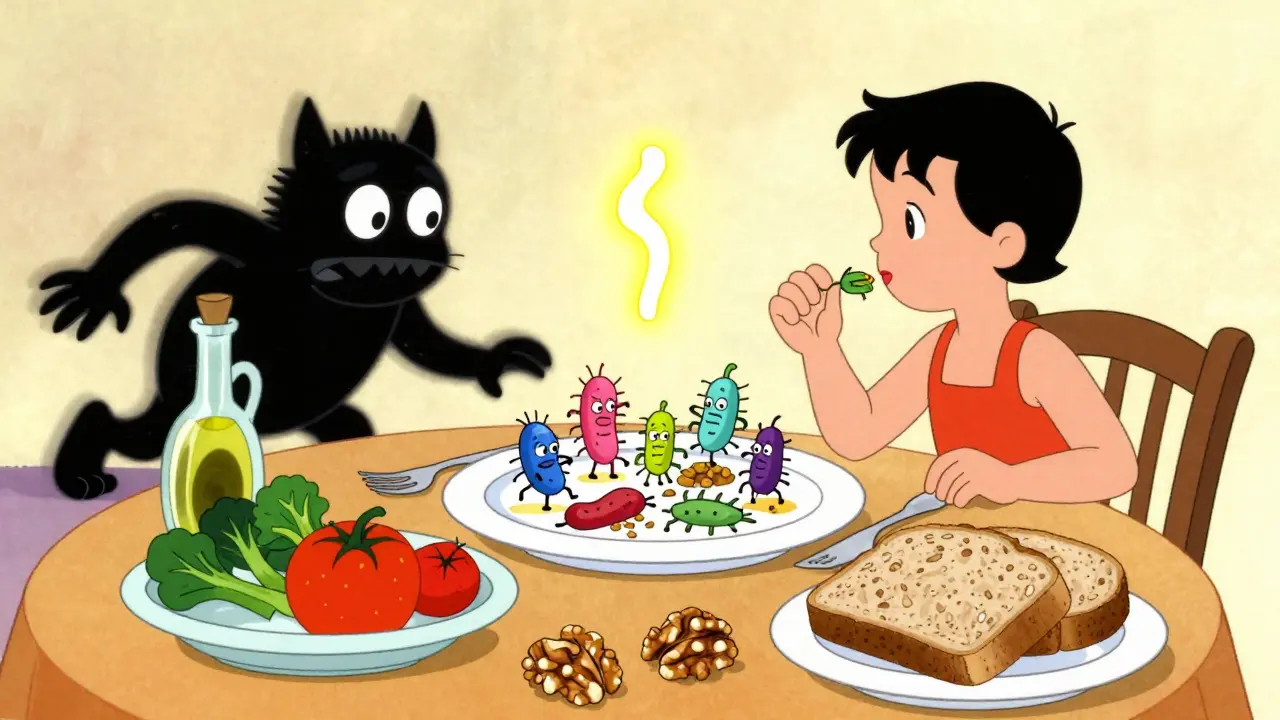
Weight Loss Isn’t Optional-It’s the Cure
You can’t out-eat a bad metabolism. But you can fix it-with weight loss. Losing just 5% of your body weight improves liver fat in 81% of people with NAFLD. Lose 7-10%, and you have a real shot at reversing inflammation and early scarring. In one study, 45% of patients who lost 10% of their weight saw NASH completely disappear. The trick? Go slow. Aim for 0.5 to 1 kg (1-2 pounds) per week. That’s a daily calorie deficit of 500-750 calories. Don’t starve yourself. Just cut out the junk. Cut out sugary drinks. That’s 150-200 calories right there. Skip the afternoon cookies. Swap chips for hummus and veggies. These small changes add up. And don’t forget movement. Walking 30 minutes a day, five days a week, boosts liver enzyme levels more than diet alone. One study showed ALT (a liver damage marker) dropped 28 points with diet + exercise-versus just 15 with diet only.Probiotics and Prebiotics: Helpful, But Not Magic
You’ve probably seen ads for probiotics that claim to “heal your liver.” They’re not lying-but they’re not the whole story either. A 24-week trial with 100 NAFLD patients found that a daily probiotic blend-Lactobacillus rhamnosus GG, Bifidobacterium longum, and Streptococcus thermophilus-cut liver fat by 23% and lowered ALT by 31%. That’s impressive. But it only worked because people were also eating better and losing weight. Prebiotics-food for your good bacteria-work too. Taking 10 grams of inulin (found in chicory root, onions, garlic) daily for 12 weeks increased butyrate by 47% and reduced liver stiffness by 15%. That’s a sign of less scarring. But here’s the catch: probiotics aren’t regulated like drugs. A bottle labeled “10 billion CFU” might have 1 billion-or none. Stick to brands with clinical trials behind them. And take them consistently for at least 12 weeks. Short-term use won’t cut it.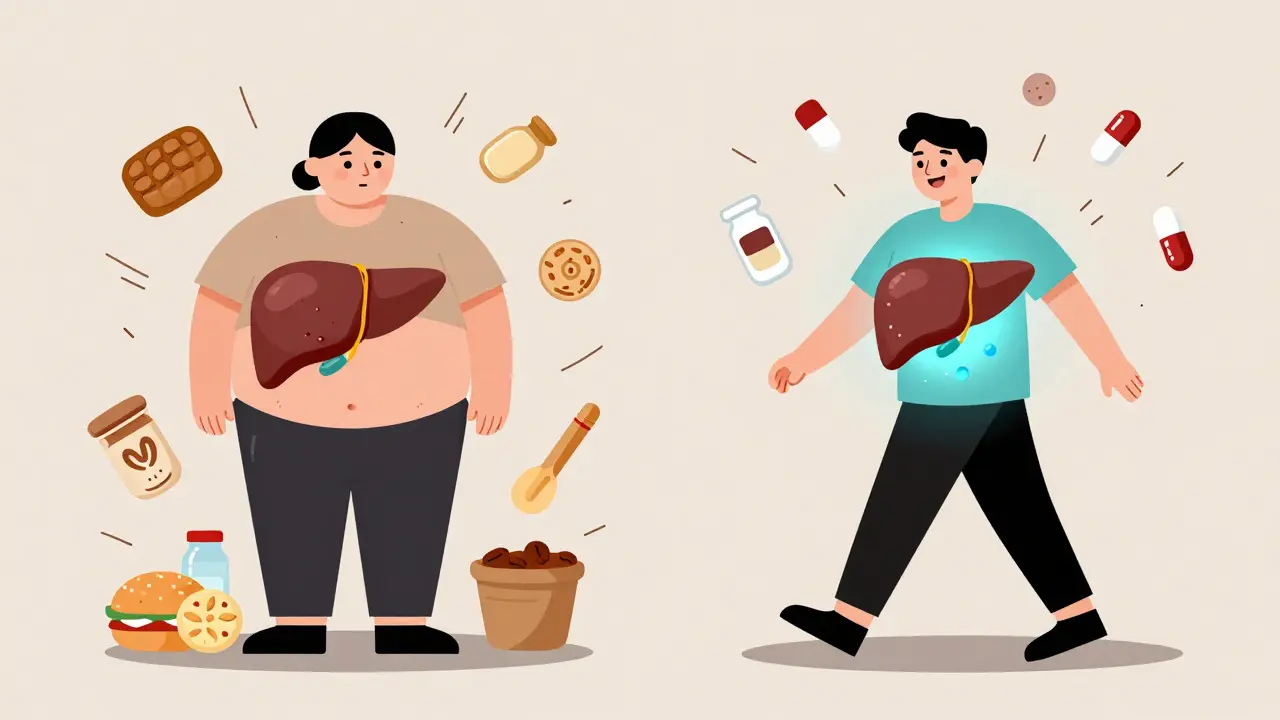
What Doesn’t Work (And Why)
Intermittent fasting? Some people swear by it. Reddit users on r/NAFLD report feeling less bloated and more energetic on 5:2 fasting. But there’s no solid evidence it’s better than steady calorie control. If you can’t stick to it, it won’t help. Extreme low-carb diets? They can work short-term, but long-term, they often reduce fiber intake-which hurts your gut bugs. And if you’re eating more saturated fat (bacon, butter, cheese), you might make liver inflammation worse. Fecal transplants? Still experimental. One small study showed slight improvement in liver enzymes, but no change in actual liver damage. Too early to recommend. And forget about liver “detox” teas or supplements. They’re expensive, unproven, and sometimes harmful.The Real Path Forward
The American Association for the Study of Liver Diseases says weight loss of 5-10% is the first-line treatment. The European Association for the Study of the Liver says probiotics are “potentially beneficial” but not standard. Both agree: diet and lifestyle are the foundation. The future is promising. New drugs targeting the gut-liver axis are in phase 3 trials. One, called VE-117, is a precise mix of bacteria designed to activate liver-protecting pathways. Early results show a 38% drop in liver fat. But you don’t need to wait for a pill. You have everything you need right now:- Start eating more plants-especially fiber-rich ones
- Drop sugary drinks and processed snacks
- Move every day-even if it’s just walking
- Give yourself time. This isn’t a 30-day fix. It’s a lifelong shift.
Can you reverse fatty liver without losing weight?
No-not reliably. While improving your diet and taking probiotics helps, weight loss is the only intervention proven to reduce liver fat and inflammation at a clinical level. Studies show that without losing at least 5% of body weight, liver fat rarely improves. Even if you eat perfectly, if you’re carrying excess weight, the metabolic stress on your liver continues. Weight loss is the trigger that allows your liver to start repairing itself.
Is the Mediterranean diet the only diet that works for NAFLD?
It’s the most studied and consistently effective, but it’s not the only one. Diets low in fructose and refined carbs-like the DASH diet or a well-formulated low-carb diet rich in vegetables and healthy fats-can also help. But many low-carb diets lack fiber, which harms the gut microbiome. The Mediterranean diet wins because it balances healthy fats, high fiber, and anti-inflammatory foods in a way that supports both liver and gut health long-term. It’s sustainable, not extreme.
Do probiotics really help NAFLD, or is it just hype?
They help-but only as part of a bigger plan. In clinical trials, specific multi-strain probiotics reduced liver fat by 20-25% and lowered liver enzymes by 30%. But these results only happened when patients also improved their diet and lost weight. Probiotics alone won’t fix NAFLD. Think of them as a supporting player, not the lead. They improve gut barrier function and reduce inflammation, but they can’t undo the damage from sugar, obesity, or inactivity.
How long does it take to see results from diet changes?
You might feel better in weeks-less bloating, more energy. But measurable liver improvements take time. Liver fat can start dropping in as little as 4-8 weeks with consistent diet and weight loss. Blood tests (like ALT levels) often improve within 12 weeks. But to reverse inflammation or early scarring, you need at least 6-12 months of sustained change. Patience and consistency matter more than speed.
Can I still drink alcohol if I have NAFLD?
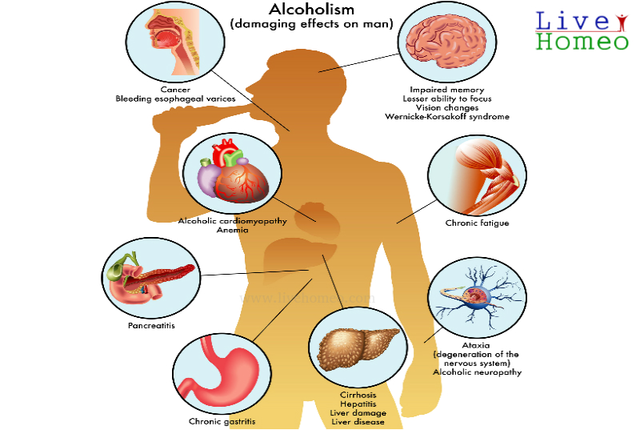
Even small amounts of alcohol can worsen liver damage in people with NAFLD. While the condition is defined by the absence of significant alcohol use, research shows that as little as one drink a day increases the risk of progression to NASH and fibrosis. The liver is already under stress. Adding alcohol is like pouring gasoline on a fire. For the best chance of recovery, avoid alcohol completely.
Are there any foods I should avoid completely?
Yes. Avoid anything with added sugar-especially high-fructose corn syrup. That includes soda, sweetened yogurts, granola bars, and even many “healthy” packaged foods. Also cut back on refined carbs like white bread, pastries, and instant rice-they spike blood sugar and get turned into liver fat. Fried foods and processed meats (bacon, sausages) add unhealthy fats and inflammation. Focus on whole, unprocessed foods instead.




Comments (10)