

Managing multiple medications is harder than it looks. You might take blood pressure pills in the morning, a thyroid tablet on an empty stomach, an antibiotic every 8 hours, and a painkiller only when needed. Add in supplements, over-the-counter drugs, and vitamins, and it’s easy to miss a dose-or worse, take two things that clash. Drug interactions don’t always cause dramatic reactions. Sometimes, they just make you feel off: dizzy, nauseous, unusually tired, or bruise easily. These aren’t just annoyances. They can land you in the hospital.
The good news? You don’t need to be a doctor to build a schedule that keeps you safe. With the right system, you can cut down on interactions, avoid side effects, and actually remember what you’re supposed to take-and when.
Start with a Complete Medication List
Before you even think about timing, you need to know exactly what you’re taking. Not just prescriptions. Include every pill, capsule, liquid, patch, or injection. That means over-the-counter pain relievers like ibuprofen or naproxen, herbal supplements like St. John’s wort or garlic pills, and even vitamins like calcium or vitamin D. Many people forget these, but they’re often the hidden cause of interactions.
Write it all down. Use a simple list: medication name, strength (like 10 mg or 500 mg), how often you take it, and why. Do this in front of your medicine cabinet. Bring it to every doctor’s visit-even if you’ve been seeing the same provider for years. A 2019 study in the Journal of the American Pharmacists Association found that when patients brought all their medications to appointments (called a “brown bag review”), pharmacists found an average of 3.2 discrepancies per person. That’s more than three mistakes in every single patient’s list. Verbal lists? They miss nearly half of what’s actually being taken.
Understand the Timing Rules
Not all pills work the same way. Some need food. Some need an empty stomach. Some need to be spaced hours apart. Ignoring these rules can make a drug useless-or dangerous.
For example: levothyroxine, used for hypothyroidism, must be taken on an empty stomach, at least 30 to 60 minutes before breakfast. If you take it with coffee, calcium, iron, or soy, your body absorbs less of it. Over time, that can mean your thyroid levels stay too low, even if you’re “taking your medicine.”
Another example: statins like atorvastatin work better when taken at night because your liver makes most cholesterol while you sleep. But if you’re also taking antibiotics like clarithromycin, that combo can raise your risk of muscle damage. They need to be separated by several hours.
This is where the Universal Medication Schedule (UMS) helps. Instead of vague instructions like “take twice daily,” UMS uses clear time blocks: morning (6-10 AM), noon (10 AM-2 PM), evening (2-6 PM), and bedtime (8 PM-12 AM). A 2020 study in JAMA Internal Medicine showed this simple change cut patient confusion from 34% down to just 6%. If your doctor says “take in the morning,” ask: “Do you mean before breakfast? After breakfast? Between 6 and 10?” Be specific.
Group Medications by Time Block
Once you have your full list, start grouping. Don’t try to space out every pill perfectly. That’s unrealistic. Instead, aim for logical clusters.
Here’s how it works:
- Morning (6-10 AM): Thyroid meds, blood pressure pills, daily vitamins, cholesterol drugs taken in the morning.
- Noon (10 AM-2 PM): Anti-inflammatories, diabetes meds, midday supplements.
- Evening (2-6 PM): Antibiotics that need 8-hour spacing (e.g., if you took one at 8 AM, take the next at 4 PM), muscle relaxants, some antidepressants.
- Bedtime (8 PM-12 AM): Sleep aids, nighttime pain relievers, statins (if prescribed at night), magnesium supplements.
Now, check for conflicts. For example: if you take calcium supplements and thyroid medication, never put them in the same time block. Calcium blocks thyroid absorption. Keep them at least 2 hours apart. So take calcium in the evening, thyroid in the morning.
Same with anticoagulants like warfarin and NSAIDs like ibuprofen. The American Geriatrics Society’s Beers Criteria (2023) warns this combo increases bleeding risk by 60-70%. If you need pain relief, ask your doctor about acetaminophen instead-it’s safer with blood thinners.
Use a Pill Organizer and Calendar
Memory fails. Even the most organized people forget. That’s why tools matter.
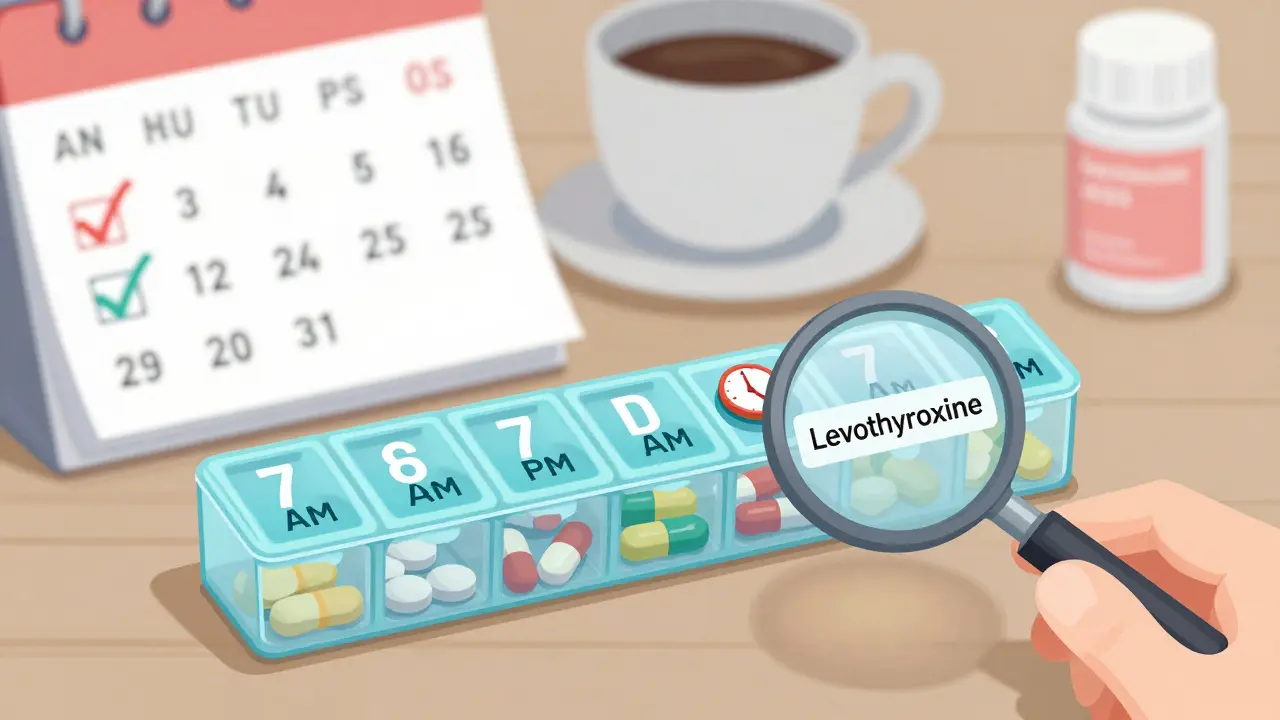
A 7-day pill organizer with AM/PM compartments cuts dosing errors by 45%, according to a 2018 meta-analysis in the Annals of Internal Medicine. Choose one with labeled compartments. Don’t just use a random box. If you take 8 pills at once, you need a multi-compartment box-not a simple two-slot one.
Pair it with a written calendar. Tape it to the wall next to your meds. Write the date, time, and medication name next to each slot. Mark off each dose with a checkmark or highlighter. Studies show this simple habit lifts adherence from 50% to 75% for people with chronic conditions like diabetes or heart failure.
Some people swear by apps like Medisafe or MyTherapy. They send reminders and track refills. But here’s the catch: only 38% of people over 65 use them consistently. If you’re not tech-savvy, a paper calendar works just as well. It doesn’t need Wi-Fi. It doesn’t need charging. And you can’t accidentally mute it.
Synchronize Your Refills
Getting 10 different prescriptions due on 10 different days is exhausting. You’re constantly running to the pharmacy, forgetting refills, or missing doses while waiting for a new bottle.
The solution? Medication synchronization. Ask your pharmacist to align all your prescriptions to be refilled on the same day each month. Most pharmacies offer this for free. It’s called the “90 x 4” approach: get a 90-day supply, refill four times a year. This saves you time, reduces missed doses, and cuts down on pharmacy visits.
The American Medical Association says this can save clinicians up to two hours per day by reducing administrative work. For you? It means one trip to the pharmacy instead of four. One conversation with your pharmacist instead of ten.
Know the Red Flags
Even with a perfect schedule, things can go wrong. Watch for these signs:
- Sudden dizziness or lightheadedness
- Unexplained bruising or bleeding
- Severe stomach pain or vomiting
- Confusion or memory lapses
- Unusual fatigue or weakness
- Rash or swelling
If you notice any of these after starting a new med or changing your schedule, don’t wait. Call your pharmacist or doctor. These aren’t normal side effects-they’re warning signs of an interaction.
For example: mixing SSRIs (like sertraline) with triptans (for migraines) can cause serotonin syndrome-a rare but life-threatening condition. Symptoms include high fever, rapid heartbeat, and muscle rigidity. It’s not something you ignore.

Work With Your Pharmacist
Pharmacists aren’t just pill dispensers. They’re medication experts trained to spot interactions you might miss.
Many offer free Medication Therapy Management (MTM) sessions. In these 20-30 minute chats, they review your entire list, check for duplicates, flag risks, and suggest simpler alternatives. A 2020 study in the American Journal of Health-System Pharmacy found that patients who got MTM from a pharmacist had 32% fewer drug interactions and 24% fewer emergency room visits.
Don’t wait for a crisis. Ask your pharmacist: “Can we do a full med review?” Bring your list. Bring your pills. Bring your calendar. They’ll thank you.
What If You See Different Doctors?
This is the biggest problem for people on multiple meds. One doctor prescribes a new antibiotic. Another adds a painkiller. A third suggests a supplement. No one talks to each other.
A 2022 study in JAMA Internal Medicine found patients see an average of 13.1 specialists over five years. That’s 13 different people giving you different instructions. No wonder 67% of people report conflicting timing advice.
Here’s how to fix it: keep one master list. Update it after every appointment. Give a copy to every provider-even your dentist. Say: “I’m on 10 medications. Can you check this list before prescribing anything new?”
Electronic health records are getting better. Epic Systems, used by 78% of U.S. healthcare systems, now supports UMS timing in e-prescriptions. But not all systems talk to each other. You’re still the only one who knows your full picture. Be your own advocate.
Start Small. Stay Consistent.
You don’t need to fix everything overnight. Pick one thing to start:
- Make your medication list today.
- Buy a pill organizer this week.
- Ask your pharmacist for a med review next month.
Most people who succeed with medication schedules don’t have perfect systems. They have consistent ones. They check their list. They use their organizer. They call when something feels off.
Medication scheduling isn’t about being perfect. It’s about being safe. And with the right plan, you can take control-without feeling overwhelmed.






Comments (12)