
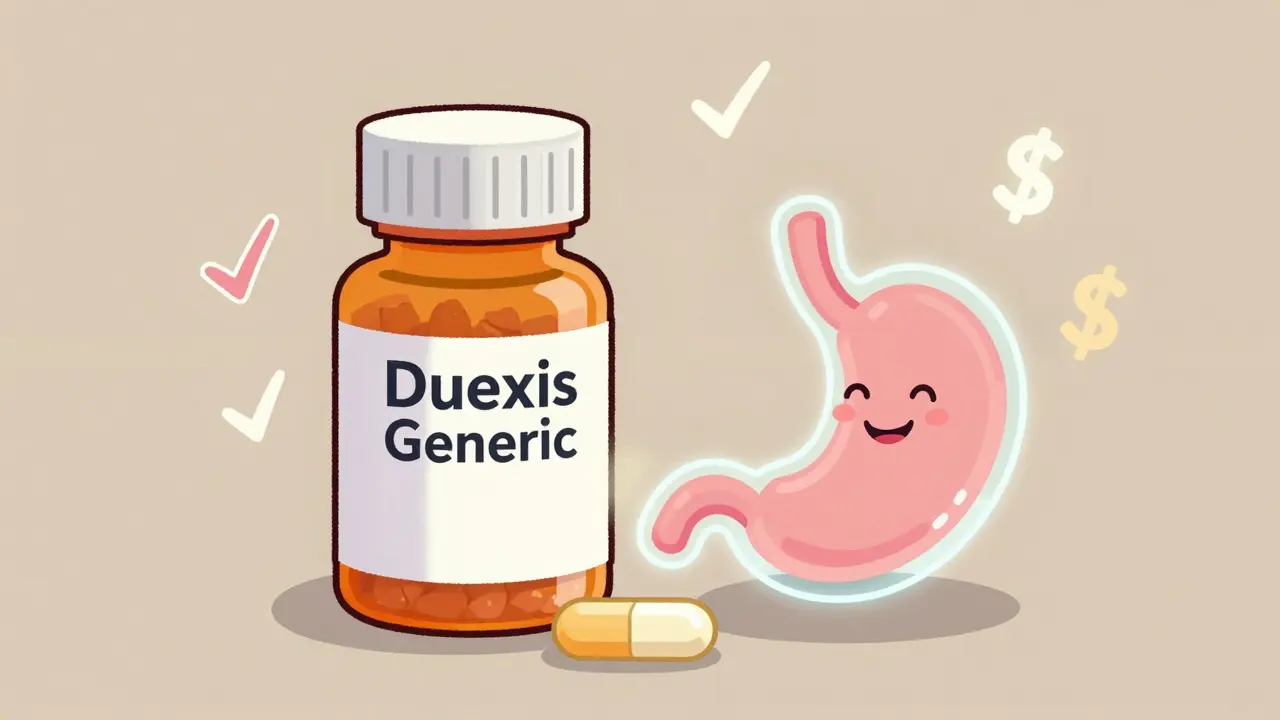
When you’re dealing with stomach issues like acid reflux, ulcers, or irritable bowel syndrome, doctors often prescribe gastrointestinal combination products - pills that pack two or more active ingredients into one tablet. These aren’t just convenient. They’re designed to work better together than separately. But here’s the real question: can you get these same combinations cheaply as generics? And if not, what else works?
What Are Gastrointestinal Combination Products?
These are pills that combine two or more drugs to treat digestive conditions with a single dose. Think of them as a one-pill solution for problems that need more than one fix. For example, if you have arthritis pain but also a history of stomach ulcers, your doctor might prescribe a combo of ibuprofen (to reduce pain) and famotidine (to protect your stomach lining). That’s Duexis - a branded combo that’s now available as a generic. Another common example is H. pylori treatment. This bacteria causes most peptic ulcers. Eradicating it usually requires three drugs: a proton pump inhibitor (PPI) like omeprazole, plus two antibiotics - typically amoxicillin and clarithromycin. These are often bundled into a single regimen, sometimes called a “triple therapy.” Newer combos are popping up too. Vonoprazan (brand name Voquezna), approved in July 2024, is a potassium-competitive acid blocker. It works differently than traditional PPIs and is used for heartburn caused by nonerosive GERD. It’s not generic yet - but it’s the next big thing.Which Combination Products Have Generic Versions?
Not all combos are created equal when it comes to generics. Some have been on the market long enough for patents to expire. Others are still protected. The most notable generic success story is ibuprofen-famotidine. The brand Duexis was approved in 2010. In August 2021, the FDA approved its first generic version from Par Pharmaceutical. Alkem Laboratories followed soon after. Today, you can buy generic ibuprofen 800 mg + famotidine 26.6 mg tablets at most pharmacies. They’re FDA-approved as “A-rated,” meaning they’re considered therapeutically equivalent to the brand. Linaclotide (Linzess), used for IBS-C and chronic constipation, also got its first generic in February 2021 from Mylan. That’s another win for cost-conscious patients. Standalone PPIs like omeprazole, pantoprazole, and esomeprazole have been generic for years. But here’s the catch: while the individual drugs are cheap, the fixed-dose combo isn’t always available as a generic - even if the parts are. For example, you can buy omeprazole and amoxicillin separately, but the exact combo tablet for H. pylori? Not always. That means you might have to take three pills instead of one - which affects adherence.What’s Still Blocked From Generic Entry?
Some newer combos are still under patent protection. Vonoprazan (Voquezna) is the biggest one right now. Approved in July 2024, it’s still brand-only. That means it’s expensive - likely over $500 per month without insurance. But expect generics to arrive in 2028 or 2029, once the patent window closes. Janumet (sitagliptin + metformin), used for type 2 diabetes but sometimes prescribed off-label for metabolic issues linked to gut health, is also still brand-protected. But it’s expected to go generic in 2026. That’s a big deal because metformin alone costs less than $10 a month. The combo could drop to under $30 once generics hit. Xifaxan (rifaximin), used for traveler’s diarrhea and IBS-D, lost exclusivity in 2024 after 20.7 years on the market. That means generic versions are now available - a major win for patients who need it for long-term symptom control.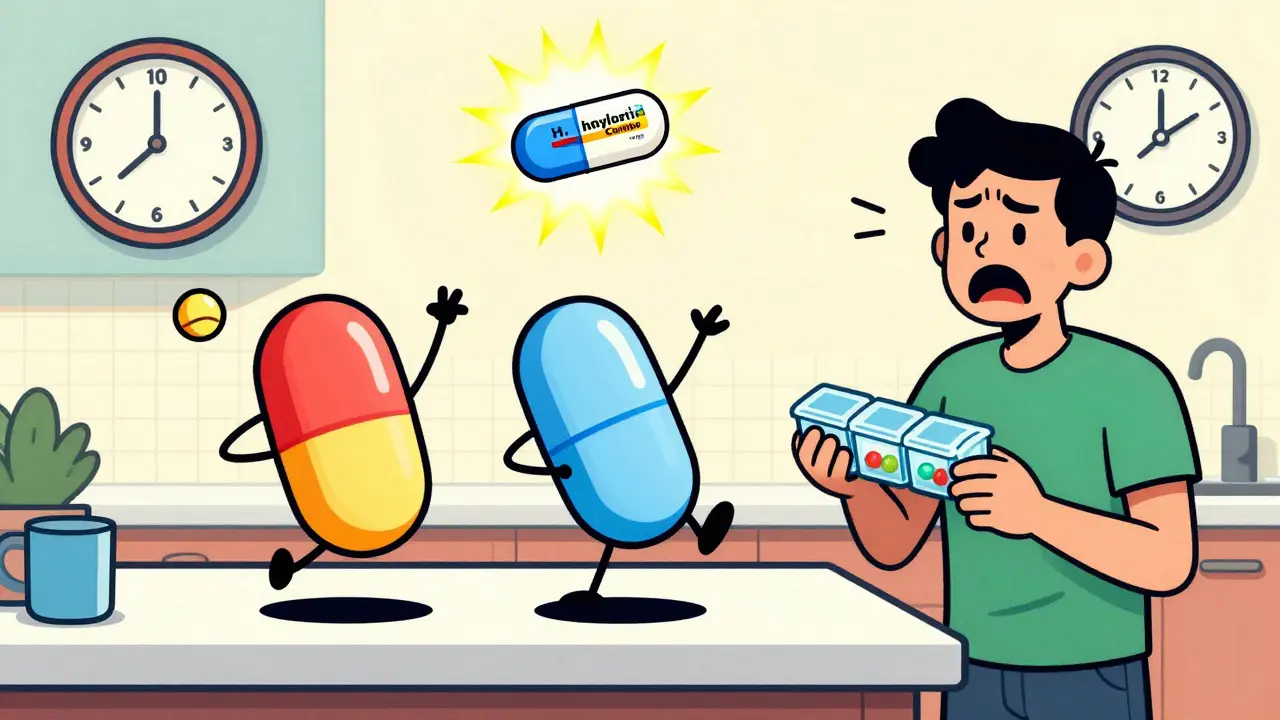
Why Can’t You Just Buy the Ingredients Separately?
You technically can. But it’s not always practical. Take H. pylori treatment. You could buy omeprazole, amoxicillin, and clarithromycin individually. But here’s the problem: the timing matters. You need to take them together, at specific intervals, for 10-14 days. Missing a dose or taking them at the wrong time reduces effectiveness. A combo pill ensures you get the right dose at the right time. Also, insurance doesn’t always cover separate drugs the same way. Many formularies require prior authorization for branded combos - but not for the individual components. So if you’re on Medicaid or Medicare, you might be forced to take three pills instead of one, even if the combo is more effective. Some insurers even require proof you tried and failed the generic versions before approving the combo. That means a paper trail of failed treatments before you get the drug your doctor thinks you need.What Are the Best Alternatives?
If a combo isn’t available as a generic - or your insurance won’t cover it - what can you do? Option 1: Take the ingredients separately. This works if you’re good at managing multiple pills and your insurance allows it. For example, if you need PPI + antibiotic for H. pylori, buy generic omeprazole 20 mg and generic amoxicillin 500 mg. Take them together as directed. Just make sure your pharmacist confirms the dosing schedule. Option 2: Switch to a different combo. If vonoprazan is too expensive, stick with omeprazole or pantoprazole. They’re cheaper, proven, and still effective for most people. For IBS-C, if Linzess is out of reach, try lubiprostone (Amitiza) or plecanatide (Trulance) - both have generics available. Option 3: Use over-the-counter options. For mild acid reflux, OTC famotidine (Pepcid) or omeprazole (Prilosec OTC) work well. For diarrhea, loperamide (Imodium) is available without a prescription and has been FDA-approved for decades. Option 4: Consider biosimilars for immune-related gut diseases. If you have Crohn’s or ulcerative colitis, newer biologics like ustekinumab-ttwe (Pyzchiva) - a biosimilar to Stelara - offer the same effect at a lower cost. They’re not combos per se, but they’re part of the evolving landscape.
How Do Insurance and Prior Authorization Work?
This is where things get messy. Most insurance plans, especially Medicare Part D, treat combination drugs as unique entities. That means Janumet is negotiated separately from Januvia (sitagliptin alone) or metformin. This affects pricing. The government’s drug negotiation program doesn’t group combos - each is its own drug. Formularies like MassHealth’s rules say: if a brand-name combo has an FDA “A-rated” generic, you must try the generic first. Only if you have an adverse reaction - documented by your doctor - can you get the brand. For higher-dose PPIs (like omeprazole over 40 mg daily), you’ll need prior authorization. You’ll need to show you have Zollinger-Ellison syndrome, Barrett’s esophagus, or erosive esophagitis. If you’re under 13, you usually get approved without paperwork. Bottom line: don’t assume your doctor’s prescription will be covered. Call your pharmacy first. Ask: “Is there a generic? If not, what’s the prior auth process?”What’s Coming Next?
The GI drug market is growing fast - projected to hit $96 billion by 2035. More combos are on the horizon. Maralixibat (Livmarli), approved in July 2024 for rare liver conditions causing severe itching, is one example. It’s not a combo, but it shows how targeted therapies are expanding. Another is risankizumab-rzaa, a new IL-23 inhibitor approved for both Crohn’s and ulcerative colitis. Expect more fixed-dose combos in the next 3-5 years. Researchers are testing PPIs with new antibiotics, or acid blockers with motility agents. But until then, the best strategy is simple: know what’s generic, what’s not, and what alternatives your doctor can prescribe.What Should You Do Today?
If you’re on a GI combo drug:- Ask your pharmacist: “Is there a generic version?”
- Check if your insurance requires prior authorization - and what documentation they need.
- If the combo is too expensive, ask your doctor: “Can I take the components separately?”
- For H. pylori, confirm you’re getting the right antibiotic combo - clarithromycin resistance is rising in some areas.
- For acid reflux, try OTC PPIs first. If they don’t work, then consider a prescription combo.
Are generic gastrointestinal combination products as effective as brand-name ones?
Yes, if they’re FDA-approved as “A-rated.” That means the generic has the same active ingredients, strength, dosage form, and absorption rate as the brand. For example, the generic version of ibuprofen-famotidine (Duexis) works just as well. The FDA requires bioequivalence testing before approval. The only differences are inactive ingredients - like fillers or dyes - which rarely affect how the drug works.
Why is vonoprazan still brand-only, and when will a generic be available?
Vonoprazan (Voquezna) was approved by the FDA in July 2024. It’s protected by patents that typically last 20 years from the date of filing. Even though it’s new, generic versions won’t be available until at least 2028-2029, depending on patent extensions. Until then, it’s only sold under the brand name and costs significantly more than traditional PPIs.
Can I split my GI combo pill or take it with food?
Never split a pill unless your doctor or pharmacist says it’s safe. Some combo tablets are designed with special coatings to release ingredients at different times. Splitting them could ruin that. As for food: it depends. Ibuprofen-famotidine combos are usually taken with food to reduce stomach upset. PPIs like omeprazole are often taken 30 minutes before meals. Always check the label or ask your pharmacist.
What if my insurance denies coverage for a combination drug?
If your insurance denies coverage, ask your doctor to file an appeal. They’ll need to submit medical records showing you tried the generic version and had side effects or no improvement. Some insurers also require a GI consult note. If you’re on Medicaid or Medicare, you can also request a formulary exception. Don’t give up - many denials are overturned with proper documentation.
Are there any over-the-counter alternatives to prescription GI combos?
For mild symptoms, yes. OTC omeprazole (Prilosec OTC) or famotidine (Pepcid) can manage acid reflux. Loperamide (Imodium) helps with diarrhea. But if you’re dealing with H. pylori, IBS-C, or chronic inflammation, OTC options won’t cut it. Prescription combos are designed for specific, complex conditions. Don’t self-treat serious GI issues - see your doctor.
If you’re managing a chronic gut condition, knowledge is your best tool. Know your meds. Know your insurance rules. And don’t be afraid to ask for alternatives. The right combo - generic or brand - should help you feel better, not break the bank.




Comments (14)