
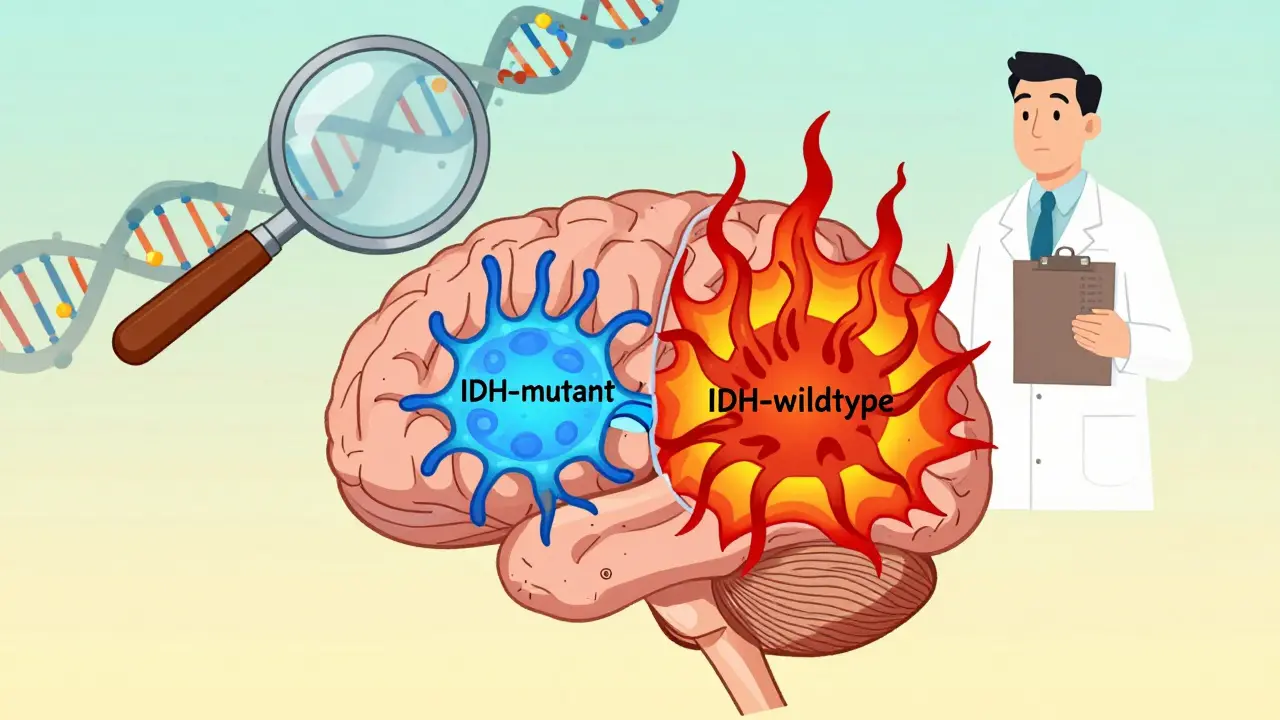
When someone hears the word brain tumor, fear often comes first. But not all brain tumors are the same. Some grow slowly over years. Others spread aggressively within weeks. The difference isn’t just in how they look under a microscope-it’s in their biology, their genes, and how they respond to treatment. Today’s understanding of brain tumors has changed dramatically since just five years ago. What used to be labeled simply as "high-grade" or "low-grade" now comes with molecular profiles that can predict survival, guide therapy, and even open doors to clinical trials that weren’t possible before.
How Brain Tumors Are Classified: Beyond Just "Benign" or "Malignant"
For decades, doctors grouped brain tumors as either benign (non-cancerous) or malignant (cancerous). That’s too simple now. The World Health Organization’s 2021 classification system-called WHO CNS5-completely rewrote the rules. It doesn’t just look at how cells appear under a microscope. It looks at their DNA. Two tumors that look identical under a microscope can behave completely differently if one has an IDH mutation and the other doesn’t.
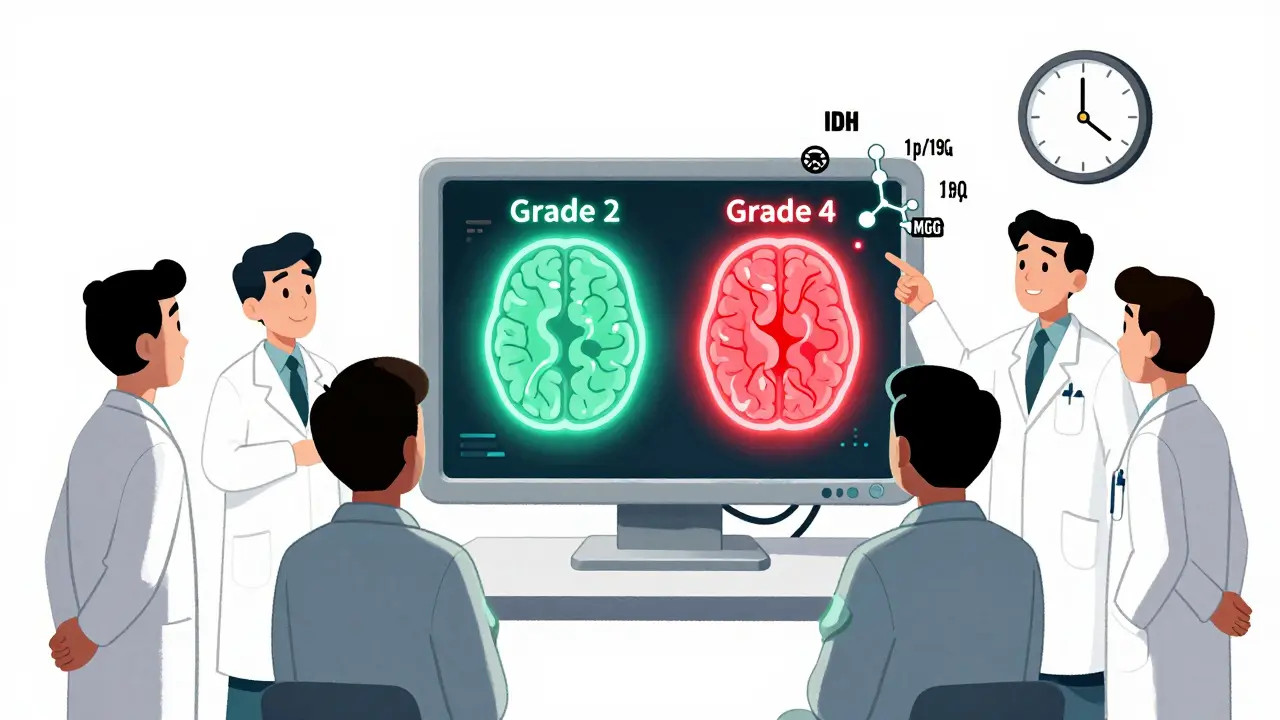
Take gliomas, for example. These are the most common type of primary brain tumor in adults. Before 2021, an anaplastic astrocytoma was always grade 3. Now, it could be grade 2, 3, or 4-depending on whether it has an IDH mutation, 1p/19q codeletion, or MGMT promoter methylation. That’s the big shift: grading is now tied to the tumor type, not just how abnormal the cells look.
Here’s how it breaks down:
- Astrocytoma, IDH-mutant: Can be grade 2, 3, or 4. Grade 4 here is different from glioblastoma-it grows slower and responds better to treatment.
- Oligodendroglioma, IDH-mutant and 1p/19q-codeleted: Only grades 2 and 3. These tumors are often more responsive to chemotherapy.
- Glioblastoma, IDH-wildtype: Always grade 4. This is the most aggressive form. It’s what most people think of when they hear "brain cancer."
Other tumors like meningiomas and solitary fibrous tumors have their own grading systems-1 to 3-but they don’t use the same molecular markers as gliomas. That’s why knowing the exact tumor type matters more than ever.
What Brain Tumor Grades Really Mean
Grades don’t just describe how fast a tumor grows-they predict how it will behave and how it will respond to treatment. Here’s what each grade means in real terms:
- Grade 1: These tumors look almost normal under the microscope. They grow slowly, rarely spread, and are often curable with surgery alone. Pilocytic astrocytoma is the most common type here. Many patients live normal lifespans after removal.
- Grade 2: Cells are slightly abnormal. They grow slowly but can invade nearby brain tissue. They often come back, sometimes as a higher grade. Patients might live 10+ years, but monitoring is lifelong. Many need radiation or chemo after surgery.
- Grade 3: These are anaplastic tumors. Cells are clearly abnormal and dividing rapidly. They invade deeply and usually come back. Survival is often 5-10 years with treatment. Oligodendrogliomas at this grade respond well to PCV chemotherapy (procarbazine, lomustine, vincristine).
- Grade 4: The most aggressive. Glioblastoma (IDH-wildtype) falls here. It grows fast, forms its own blood supply, and leaves behind dead tissue in the center. Median survival without treatment is under 3 months. With standard care-surgery, radiation, and temozolomide-it’s about 14.6 months. But if it’s IDH-mutant, survival jumps to over 31 months.
One big misconception? Grade 2 doesn’t mean you have a 20% chance of survival. That’s what 42% of patients in one study believed. The truth? Many grade 2 patients live decades. The grade tells you about growth speed and recurrence risk-not death sentence.
How Diagnosis Has Changed: Molecular Testing Is Now Standard
Before 2021, a brain tumor diagnosis relied almost entirely on what a pathologist saw under a microscope. Now, molecular testing is non-negotiable. Every biopsy needs at least three key tests:
- IDH mutation status: Is the tumor carrying a mutation in the IDH1 or IDH2 gene? This single marker separates slow-growing tumors from aggressive ones.
- 1p/19q codeletion: If both chromosome arms are missing, it’s almost certainly an oligodendroglioma. These tumors respond better to chemo.
- MGMT promoter methylation: This tells doctors if the tumor is likely to respond to temozolomide, the main chemo drug for glioblastoma.
These tests used to take weeks. Now, with FDA-approved IDH1 IHC antibodies, results can come back in 48 hours. That’s a game-changer. It means treatment can start faster, and patients aren’t left waiting for answers while their tumor grows.
But it’s not perfect. Some tumors still defy easy classification. Dr. Kenneth Aldape from the National Cancer Institute admits: "For some tumor types, definite grading criteria and understanding of natural history are not yet known." That’s why centers like Johns Hopkins and UCSF now have multidisciplinary tumor boards where neurosurgeons, oncologists, and pathologists meet weekly to review complex cases.
Treatment Today: It’s Not One-Size-Fits-All
There’s no single treatment for brain tumors anymore. What works for one patient might not help another-even if they have the same tumor grade. Treatment is now a mix of surgery, radiation, chemotherapy, and targeted drugs-chosen based on molecular profile.
For low-grade tumors (grade 1-2), surgery is often enough. But if the tumor is in a sensitive area like the motor cortex, doctors may wait and watch. Radiation and chemo are held off until there’s clear growth.
For high-grade tumors, the approach is aggressive:
- Surgery: Goal is maximal safe resection. Removing 98% of the tumor can double survival compared to removing only 70%.
- Radiation: Standard for grades 3 and 4. Often delivered over 6 weeks.
- Chemotherapy: Temozolomide is the go-to for glioblastoma. For oligodendroglioma, PCV is preferred.
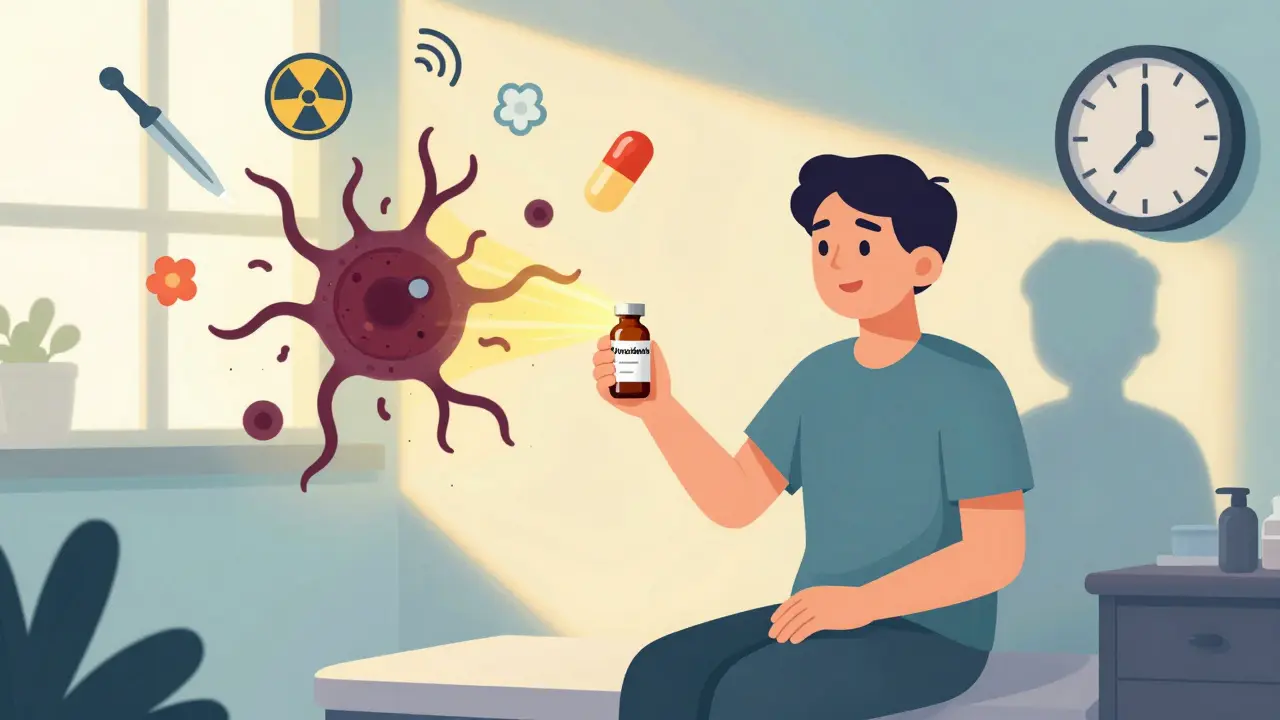
But the biggest breakthrough came in June 2023: the FDA approved vorasidenib for IDH-mutant grade 2 gliomas. In the INDIGO trial, patients on vorasidenib had a median progression-free survival of 27.7 months-nearly triple the 11.1 months seen with placebo. That’s not just an extension. It’s a delay in needing radiation or chemo, which can damage healthy brain tissue.
For patients with IDH-mutant grade 4 astrocytoma, vorasidenib is now being tested in clinical trials. Early results show promise. This drug doesn’t cure-but it buys time. And in brain cancer, time is everything.
What Patients Are Saying: Real Stories Behind the Data
Behind every statistic is a person. On Reddit’s r/BrainTumors, a 32-year-old woman diagnosed with grade 2 oligodendroglioma wrote: "I had 72 hours to decide if I wanted to freeze my eggs before surgery. No one told me how fast this would all move."
Another patient, "GBMWarrior87," shared on the National Brain Tumor Society forum: "My grade 4 astrocytoma was IDH-mutant. I joined the INDIGO trial. I’m 18 months out-progression-free. My oncologist said that’s longer than 90% of patients get with standard care."
But not everyone has access. A 2022 survey of 1,247 UK patients found that 68% waited over 8 weeks for a diagnosis. Those with low-grade tumors waited longer-14.2 weeks on average. Delays like this aren’t just frustrating. They can mean the difference between treatment that works and treatment that’s too late.
The Future: Liquid Biopsies, AI, and Personalized Medicine
The next wave of brain tumor care is coming fast. Researchers are now testing liquid biopsies-blood or spinal fluid tests that detect tumor DNA. A study in Nature Medicine in August 2023 showed these tests could detect tumor DNA in cerebrospinal fluid with 89% accuracy. That means fewer invasive surgeries just to get a sample.
AI is also helping pathologists spot patterns humans miss. At Stanford, algorithms are being trained to predict tumor grade from MRI scans alone-before surgery. That could help surgeons plan better.
And clinical trials are expanding. The CODEL trial, testing combined chemo for oligodendroglioma, will release results in late 2024. If it works, it could become the new standard for grade 3 tumors.
The goal? Move from treating a tumor by its location or grade, to treating it by its genetic fingerprint. That’s the future-and it’s already here for some patients.
What You Need to Know If You or Someone You Love Is Diagnosed
If you’re facing a brain tumor diagnosis, here’s what to ask:
- What’s the exact tumor type and WHO grade?
- Have IDH, 1p/19q, and MGMT tests been done?
- Is this tumor eligible for any clinical trials?
- What are the risks and benefits of waiting versus starting treatment now?
- Can I get a second opinion from a specialized neuro-oncology center?
Don’t settle for a basic diagnosis. Ask for molecular testing. Ask for a tumor board review. Ask about trials. The more you know, the more power you have.
Survival isn’t just about the grade anymore. It’s about the mutation. It’s about the treatment plan. It’s about the team behind you. And with new drugs like vorasidenib, the outlook for many brain tumor patients is better than it’s ever been.
Are all brain tumors cancerous?
No. Many brain tumors are not cancerous. Grade 1 tumors, like pilocytic astrocytomas, are slow-growing and often curable with surgery alone. They don’t spread like cancer, but they can still cause serious problems by pressing on brain tissue. Even low-grade tumors (grade 2) can be dangerous because they infiltrate healthy brain areas. So "non-cancerous" doesn’t mean "harmless."
What does IDH mutation mean for my prognosis?
An IDH mutation is one of the most important positive factors in brain tumor prognosis. Patients with IDH-mutant gliomas-whether grade 2, 3, or even 4-live significantly longer than those with IDH-wildtype tumors. For example, IDH-mutant grade 4 gliomas have a median survival of 31 months, compared to 14.6 months for IDH-wildtype glioblastomas. This mutation makes tumors more responsive to treatment and less aggressive overall.
Why does my doctor need a biopsy if I already had an MRI?
MRI shows the size and location of a tumor, but it can’t tell you the exact type or grade. Two tumors can look identical on an MRI-one could be a slow-growing grade 2 astrocytoma, the other a fast-growing grade 4 glioblastoma. Only a biopsy lets pathologists check the cells under a microscope and run molecular tests like IDH and 1p/19q. That’s the only way to know for sure what you’re dealing with.
Is there a cure for glioblastoma?
There is currently no cure for glioblastoma, IDH-wildtype-the most common and aggressive form. But treatment has improved. The Stupp protocol (surgery, radiation, temozolomide) extends survival from under 3 months to about 14.6 months on average. For the 10% of patients with IDH-mutant glioblastoma, survival can be over 3 years. New drugs like vorasidenib and immunotherapies in trials are offering hope for longer, better-quality lives, even if a cure isn’t yet possible.
How long does it take to get a brain tumor diagnosis?
A basic diagnosis from biopsy can take 7-10 business days. But with full molecular testing-IDH, 1p/19q, MGMT-it can take 2-3 weeks. In some places, rapid IDH testing with IHC antibodies cuts that to 48 hours. Delays are common, especially in areas without specialized labs. Patients with low-grade tumors often wait longer because they’re not seen as urgent, even though early intervention can change outcomes.
Can brain tumors be prevented?
There’s no proven way to prevent most brain tumors. Unlike lung cancer and smoking, or skin cancer and sun exposure, there’s no clear environmental trigger for most types. Radiation exposure (like from childhood head radiation therapy) increases risk slightly. Genetics play a role in rare syndromes like neurofibromatosis, but these account for less than 5% of cases. For the vast majority, brain tumors happen without warning and without clear cause.
Where to Go Next
If you’re navigating a diagnosis, start with reliable sources: the National Brain Tumor Society, the American Association of Neurological Surgeons, and the World Health Organization’s Blue Books. Avoid relying on social media anecdotes. Join a patient support group-many are run by survivors who’ve been through the same tests, delays, and treatment decisions.
The landscape of brain tumor care has changed. It’s no longer about one-size-fits-all treatment. It’s about precision-knowing your tumor’s DNA, matching it to the right therapy, and fighting not just the tumor, but the clock. The tools are here. The knowledge is here. What matters now is using it.




Comments (8)